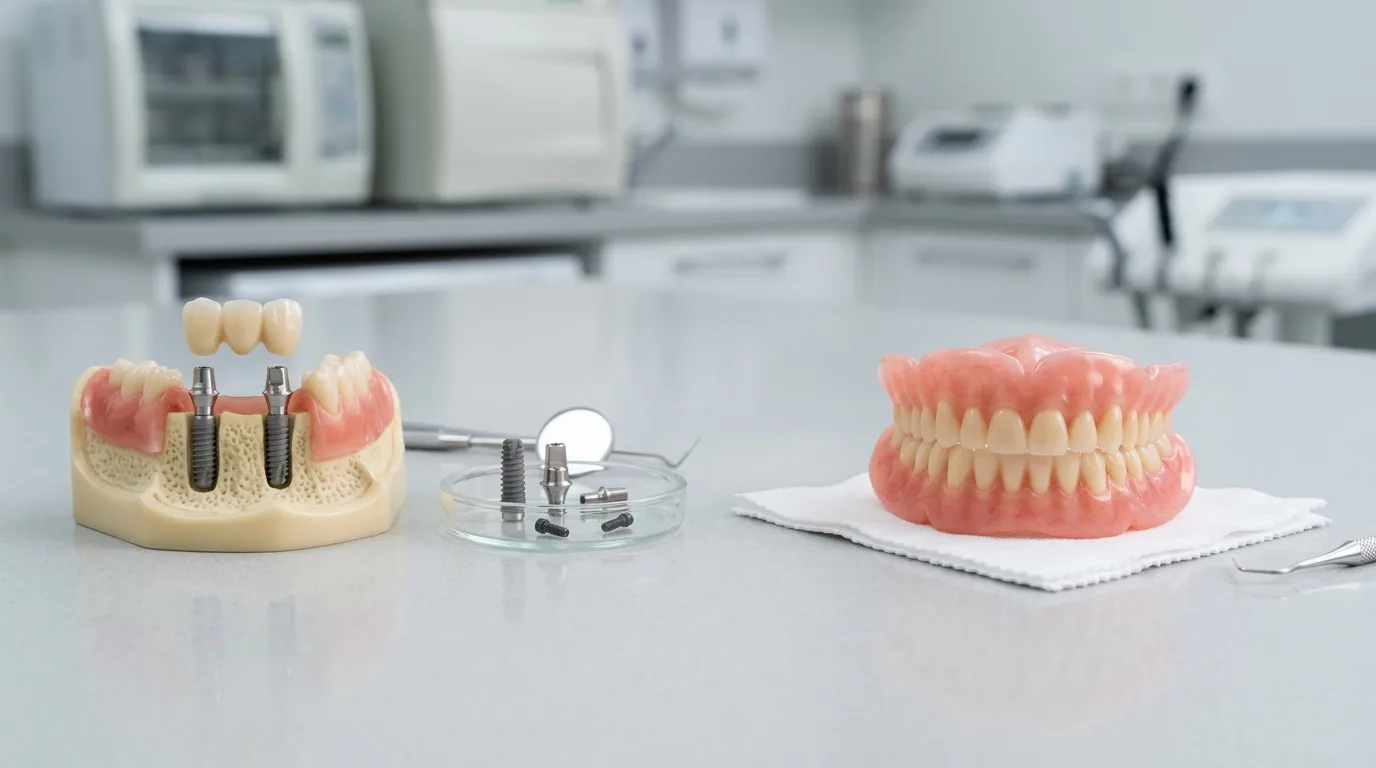
Losing one or more teeth changes more than your smile. It affects the way you eat, the way you speak, and — over time — the very shape of your face. For decades, removable dentures were the default solution for missing teeth. Today, dental implants offer a permanent, fixed alternative that looks, feels, and functions like natural teeth. But implants are not automatically the right choice for every patient, and dentures have evolved significantly from the bulky acrylic plates of a generation ago.
If you are weighing your options on Long Island, this guide breaks down the real differences between dental implants and dentures across the factors that matter most: function, comfort, bone health, longevity, cost, and candidacy. We also cover the increasingly popular middle-ground option — implant-supported dentures — and include a head-to-head comparison table so you can see everything at a glance.
What Each Option Actually Is
A dental implant is a small titanium post surgically placed into the jawbone, where it fuses with the bone through a process called osseointegration over three to six months. Once integrated, the implant acts as an artificial tooth root. A custom-made porcelain crown is then attached to the implant via an abutment connector, creating a restoration that is permanently fixed in the jaw and indistinguishable from a natural tooth.
A traditional denture is a removable prosthetic made from acrylic resin (and sometimes a metal framework) that sits on top of the gums. Full dentures replace an entire arch of teeth, while partial dentures fill gaps between remaining natural teeth. Dentures rely on suction, adhesive paste, and the shape of the gum ridge for retention — they are taken out every night for cleaning and to let the tissue rest.
Stability and Bite Force
This is where the gap between implants and dentures is widest. Because implants are anchored in bone, they restore approximately 90–95% of natural bite force. You can bite into an apple, chew steak, and eat corn on the cob without a second thought. The implant does not move, shift, or rock — it is fixed in place just like the root of a natural tooth.
Conventional dentures, by contrast, restore only about 20–25% of natural bite force. They can slip during meals, especially with hard or sticky foods, and many denture wearers report avoiding certain foods entirely. Adhesive creams help, but they add a daily maintenance step and do not eliminate movement completely. Over time, as the jawbone resorbs beneath the denture (more on that next), the fit loosens further, requiring periodic relines or entirely new dentures.
Bone Preservation and Facial Structure
This is the factor that surprises most patients and the one that matters most for long-term health. When a tooth is lost, the jawbone in that area begins to resorb — the body breaks down bone that is no longer stimulated by a tooth root. Studies show that patients lose an average of 25% of ridge width within the first year after extraction, and bone loss continues progressively for years.
Dental implants halt this process. The titanium post stimulates the surrounding bone just as a natural root would, maintaining bone density and volume indefinitely. Dentures, unfortunately, accelerate bone loss because the pressure of the prosthetic sitting on the gum ridge compresses the tissue and underlying bone. Over 10–20 years, significant bone resorption leads to a sunken, aged appearance — collapsed lip support, a shortened lower face, and a pronounced chin-to-nose distance. This is sometimes called "denture face" and is one of the primary reasons patients eventually transition from dentures to implants.
Comfort and Quality of Life
Implant-supported teeth feel like your own teeth. There is nothing to remove at night, no adhesive to apply in the morning, and no worry about your teeth shifting during a conversation or a meal. Patients consistently describe the quality-of-life improvement as transformative — particularly those who wore dentures for years before switching to implants.
Dentures require a period of adaptation. New denture wearers often experience sore spots, difficulty speaking clearly, and a gagging sensation from the acrylic plate covering the palate (in upper dentures). While most patients adjust within a few weeks, the removable nature of dentures means there is always an awareness that the teeth are not truly "part of you." Social anxiety about dentures slipping or clicking during meals is common and can limit patients' willingness to eat out or speak publicly.

Longevity: How Long Does Each Option Last?
A well-placed dental implant can last 25 years or more — many last a lifetime with proper oral hygiene and regular checkups. The implant post itself rarely fails once osseointegration is complete. The crown on top may need replacement after 15–20 years due to normal wear, but that is a relatively straightforward and inexpensive procedure compared to the initial placement.
Traditional dentures, on the other hand, typically last 5–8 years before they need to be relined or remade. As the jawbone resorbs, the fit degrades, and no amount of adhesive can compensate for a denture that no longer matches the shape of the ridge. Over a 25-year span, a denture patient may go through three or four sets of dentures plus multiple reline appointments — a cumulative expense that narrows the cost gap with implants considerably.
Cost Comparison on Long Island
Upfront cost is the main reason some patients choose dentures over implants, and it is a legitimate consideration. Here is how the numbers typically break down in Nassau County:
- Single dental implant (post + abutment + crown): $3,000–$5,500
- Full-arch implants (All-on-4): $20,000– $30,000 per arch
- Implant-supported overdenture (snap-on denture on 2–4 implants): $8,000–$15,000 per arch
- Complete traditional denture (upper or lower): $1,500–$3,500
- Partial denture: $1,000–$2,500
However, the upfront price does not tell the full story. Consider a 25-year cost projection for a patient replacing a full arch:
| Expense | All-on-4 Implants | Traditional Denture |
|---|---|---|
| Initial cost | $20,000–$30,000 | $1,500–$3,500 |
| Relines (every 2–3 years) | N/A | $300–$500 × 8–10 = $2,400–$5,000 |
| Replacement dentures (every 5–8 years) | N/A | $1,500–$3,500 × 3 = $4,500–$10,500 |
| Adhesive costs (daily use) | N/A | ~$150/year × 25 = $3,750 |
| Implant crown replacement (if needed) | $1,500–$3,000 once at ~15 years | N/A |
| Estimated 25-year total | $21,500–$33,000 | $12,150–$22,750 |
While implants still cost more over 25 years, the gap shrinks dramatically — and this table does not account for the value of preserved bone, better nutrition from unrestricted eating, or the quality-of-life difference. Meadowbrook Dental Care offers flexible financing including 0% interest payment plans to help make implants accessible.
Disclaimer: These cost ranges are educational estimates for the Long Island area. Your actual investment depends on clinical factors including bone density, number of implants, and materials selected. A personalized quote requires an in-office evaluation with 3D imaging.
The Middle Ground: Implant-Supported Dentures
For patients who want more stability than a traditional denture but are not ready for a full-arch implant restoration, implant-supported overdentures (sometimes called "snap-on dentures") offer a compelling compromise. Two to four implants are placed in the jawbone, and the denture clicks onto ball or bar attachments on top of the implants. The denture is still removable for cleaning, but it is firmly retained during eating and speaking — eliminating the slipping and adhesive problems of conventional dentures.
Implant-supported overdentures also slow bone loss significantly because the implants provide some stimulation to the jawbone, although the effect is not as complete as a full-arch fixed restoration where implants bear the load across the entire arch. At $8,000–$15,000 per arch, overdentures cost more than traditional dentures but far less than All-on-4, making them a practical step up for patients on a moderate budget.
Full Comparison Table: Implants vs. Dentures
| Criteria | Dental Implants | Traditional Dentures | Implant-Supported Overdenture |
|---|---|---|---|
| How it's secured | Fused to jawbone (fixed) | Rests on gums (removable) | Snaps onto 2–4 implants (removable) |
| Bite force restored | 90–95% | 20–25% | 50–60% |
| Bone preservation | Yes — stimulates jawbone | No — accelerates bone loss | Partial — slows bone loss |
| Lifespan | 25+ years (often lifetime) | 5–8 years per set | Implants 25+ years; overdenture 7–10 years |
| Comfort | Feels like natural teeth | Can cause sore spots, gagging | Significantly better than traditional |
| Food restrictions | None | Avoid hard and sticky foods | Minimal restrictions |
| Adhesive needed | No | Usually yes | No |
| Maintenance | Brush/floss like natural teeth | Remove, soak, brush daily | Remove, clean; replace attachments yearly |
| Upfront cost (full arch) | $20,000–$30,000 | $1,500–$3,500 | $8,000–$15,000 |
| Best candidate | Adequate bone, good health, wants permanent fix | Limited budget, health issues preventing surgery | Moderate budget, wants stability without full-arch surgery |
Who Is a Better Candidate for Each?
Dental implants require sufficient jawbone density to support the titanium post, healthy gums, and overall health that allows for minor oral surgery. Most adults are good candidates, but patients with uncontrolled diabetes, heavy smoking habits, or significant bone loss may need additional treatment — such as bone grafting — before implants can be placed. At Meadowbrook Dental Care, Dr. Miguel Casañas and Dr. Bryan Tamburro use 3D cone-beam imaging to evaluate bone volume precisely before recommending a treatment path.
Dentures may be the better starting option for patients who have medical conditions that make surgery inadvisable, those who need teeth immediately (an "immediate denture" can be placed the same day as extractions), or patients whose budget does not currently allow for implant treatment. Dentures can also serve as a transitional solution — many patients wear dentures for a period and later upgrade to implant-supported restorations when the time and finances are right. Rated 4.9 stars with over 1,000 Google reviews, our Long Island team works with patients across the full spectrum of budgets and clinical situations.
Frequently Asked Questions
Am I too old for dental implants?
Age alone is not a disqualifying factor. Patients in their 70s and 80s receive implants successfully every day, provided their overall health supports minor surgery and they have adequate bone density. A consultation with imaging is the only way to determine candidacy with certainty.
How long is the dental implant process from start to finish?
The full timeline from implant placement to final crown is typically four to six months. Most of that time is the healing phase during which the implant fuses with the jawbone. You will have a temporary restoration during this period so you are never without teeth. Same-day solutions like All-on-4 can provide a fixed temporary prosthesis on the day of surgery.
Can I convert my existing dentures to implant-supported dentures?
In some cases, yes. If your existing denture is in good condition and fits well, it may be possible to retrofit it with attachments that snap onto newly placed implants. However, most patients benefit from a new denture specifically designed for implant support, as the fit and attachment locations can be optimized for the implant positions.
Does insurance cover dental implants?
Coverage varies widely. Some dental plans cover a portion of implant treatment (often 50% up to an annual maximum), while others classify implants as elective and provide no coverage. Medical insurance may contribute if tooth loss resulted from an accident or medical condition. Our team will review your benefits and help you maximize your coverage before treatment begins.
Ready to explore your options? Call Meadowbrook Dental Care at (516) 284-1234 (Mineola) or (516) 346-5757 (Plainview), or schedule online to book your consultation and find out which solution will restore your confidence and your bite.
Find Out Which Option Is Right for You
Every patient's jaw, health history, and goals are different. Schedule a consultation at our Mineola or Plainview office and get a personalized recommendation backed by 3D imaging.