The Complete Guide to Replacing Missing Teeth
From a single lost tooth to full mouth reconstruction — every option explained by the implant specialists at Meadowbrook Dental Care.
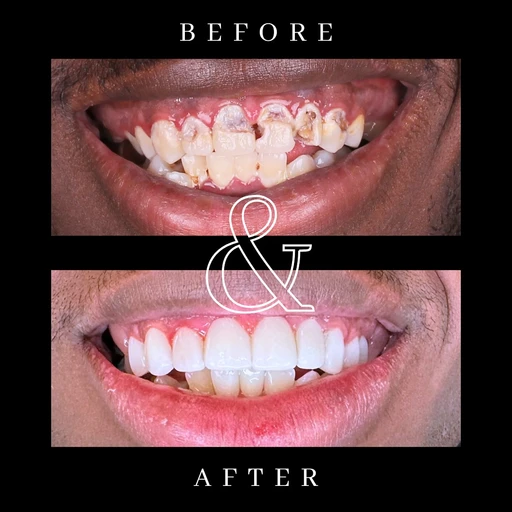

Losing a tooth — whether from decay, injury, gum disease, or simply aging — is far more than a cosmetic problem. Every missing tooth sets off a chain reaction inside your mouth: neighboring teeth shift, your bite changes, your jawbone begins to shrink, and over time, your facial structure itself can start to collapse inward. The longer you wait, the more complex (and costly) the fix becomes.
The good news? Modern restorative dentistry offers more solutions than ever before — and at Meadowbrook Dental Care, our board-certified specialists perform every single one of them under one roof. Whether you're missing a single back molar or need an entirely new smile, this guide will walk you through every option in the kind of detail that lets you walk into your consultation already informed and confident.
This guide is organized by how many teeth you're missing — because the right solution for one missing tooth is very different from the right solution for a full arch. For each option, we'll explain exactly how it works, who it's best for, the pros and cons, the typical cost range, and how we handle it at our Mineola and Plainview offices.
We'll also cover what happens if you've been told you have bone loss and think implants aren't possible (they usually still are), how to pay for treatment with insurance, financing, and our in-house Dental Savings Plan, and answers to the most common questions our Long Island patients ask every single day.
Who is this guide for? Anyone on Long Island — or anywhere — who is missing one or more teeth and wants to understand all their options before committing to treatment. Whether you've been putting this off for years or just lost a tooth last week, start here. When you're ready, schedule your free consultation at either of our offices.
Why You Should Never Ignore a Missing Tooth
It might be tempting to think a missing tooth — especially one hidden in the back of your mouth — isn't a big deal. But every tooth in your mouth plays a structural role. When even one is missing, a cascade of problems begins almost immediately, and the damage accelerates over time.
Understanding these consequences isn't about fear — it's about making an informed decision. The sooner you act, the simpler, less invasive, and less expensive the solution tends to be.
Jawbone Deterioration
Without a tooth root stimulating the bone, your jaw begins to resorb — losing up to 25% of bone width in the first year alone. This makes future implants harder and more expensive.
Teeth Shifting & Tilting
Adjacent teeth drift into the empty space. Opposing teeth over-erupt. Your bite changes, creating uneven wear, sensitivity, and potential TMJ pain.
Facial Collapse
Prolonged bone loss causes your facial structure to sag inward — cheeks hollow, lips thin, your chin moves forward. This aging effect is often irreversible without grafting.
Escalating Costs
A single dental implant today costs far less than the bone grafting, orthodontics, and complex reconstruction needed after years of neglect.
The bottom line: A missing tooth is not a cosmetic issue you can "live with." It's a progressive medical condition that gets worse every month. The best time to replace a missing tooth was the day it was lost. The second-best time is today. Schedule your consultation to stop the damage.
Your Tooth Replacement Options at a Glance
There's no single "best" solution — the right choice depends on how many teeth you're missing, your jawbone health, your budget, and your goals. Here's a quick map of everything covered in this guide.
Dental Implant
A titanium post fused to your jawbone, topped with a custom crown. The gold standard.
Dental Bridge
A false tooth anchored to neighboring teeth. No surgery needed. Quick and reliable.
Implant Bridge
Multiple teeth replaced using implant-anchored bridges. Preserves bone, no adhesive.
Partial Dentures
Removable appliance that fills gaps when some healthy teeth remain. Budget-friendly.
Full Dentures
Complete removable teeth for an entire arch. Modern versions look incredibly natural.
Snap-In Dentures
Dentures locked onto implants for zero slipping. Eat steak and corn on the cob again.
All-on-4 / All-on-6
Full arch of fixed teeth on just 4–6 implants. New smile in one day. Life-changing.
Full Mouth Recon
Comprehensive plan combining implants, crowns, bridges, and more. Total transformation.
Single Tooth Dental Implants
A dental implant is widely considered the gold standard for replacing a single missing tooth. It's the only option that replaces both the root and the crown — preserving your jawbone, protecting neighboring teeth, and delivering a result that looks, feels, and functions exactly like a natural tooth.
At Meadowbrook Dental Care, our implant team uses advanced 3D CBCT imaging and digital planning to place every implant with precision, ensuring the best possible outcome and the most comfortable experience.
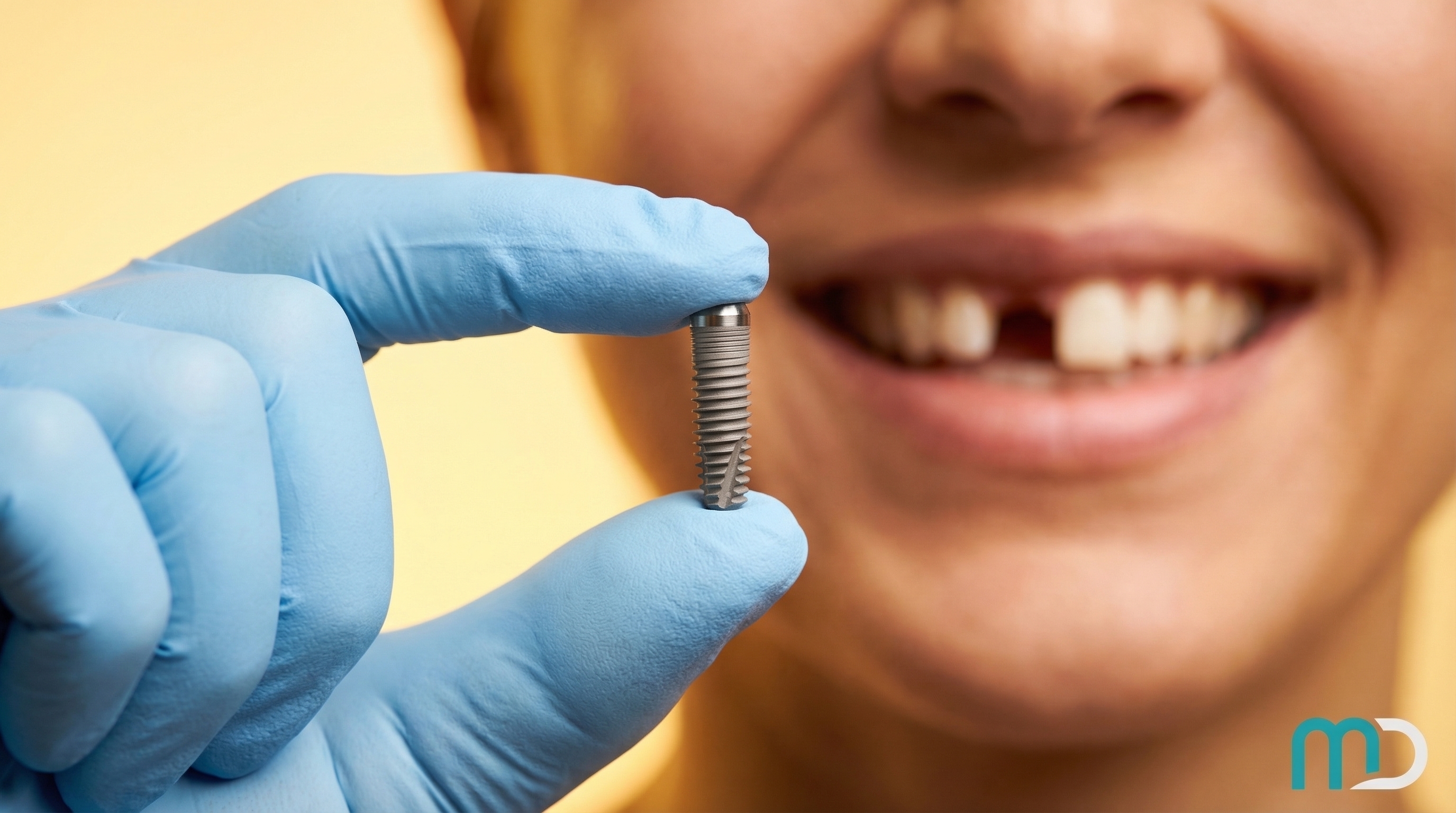
How It Works: Step by Step
1. Consultation & 3D Imaging
Your dentist takes a CBCT scan to evaluate bone density and plan the exact placement angle. This is done at your first visit at either our Mineola or Plainview office.
2. Implant Placement Surgery
A small titanium post is surgically placed into your jawbone under local anesthesia or sedation. Most patients say it's less uncomfortable than an extraction.
3. Osseointegration (Healing)
Over 3–6 months, the implant fuses with your jawbone in a process called osseointegration. This creates the rock-solid foundation that makes implants so durable.
4. Abutment & Custom Crown
Once healed, a connector (abutment) is attached, and a custom-made porcelain crown is placed on top — color-matched perfectly to your surrounding teeth.
Pros & Cons
Advantages
- Prevents jawbone loss (only option that does this)
- Looks and feels like a natural tooth
- Doesn't damage neighboring teeth
- Can last a lifetime with proper care
- 98% success rate
- Easy to clean — brush and floss normally
Considerations
- Requires minor surgery
- 3–6 month healing period
- Higher upfront cost than a bridge
- Requires sufficient jawbone (or bone grafting)
- Not ideal for uncontrolled diabetes or heavy smokers
Cost on Long Island
Is a Dental Implant Right for You?
The only way to know for sure is a 3D scan and evaluation. At Meadowbrook, your first consultation includes imaging and a personalized treatment plan — no commitment required.
Schedule Your Implant ConsultationDental Bridges
A dental bridge literally "bridges" the gap left by one to three missing teeth. It consists of a false tooth (or teeth) held in place by crowns cemented onto the healthy teeth on either side of the gap. Bridges have been a reliable tooth replacement solution for decades and remain an excellent option for patients who want a fixed, non-removable restoration without surgery.
At Meadowbrook Dental Care, we use advanced digital impressions and high-quality porcelain to create bridges that blend seamlessly with your natural smile.
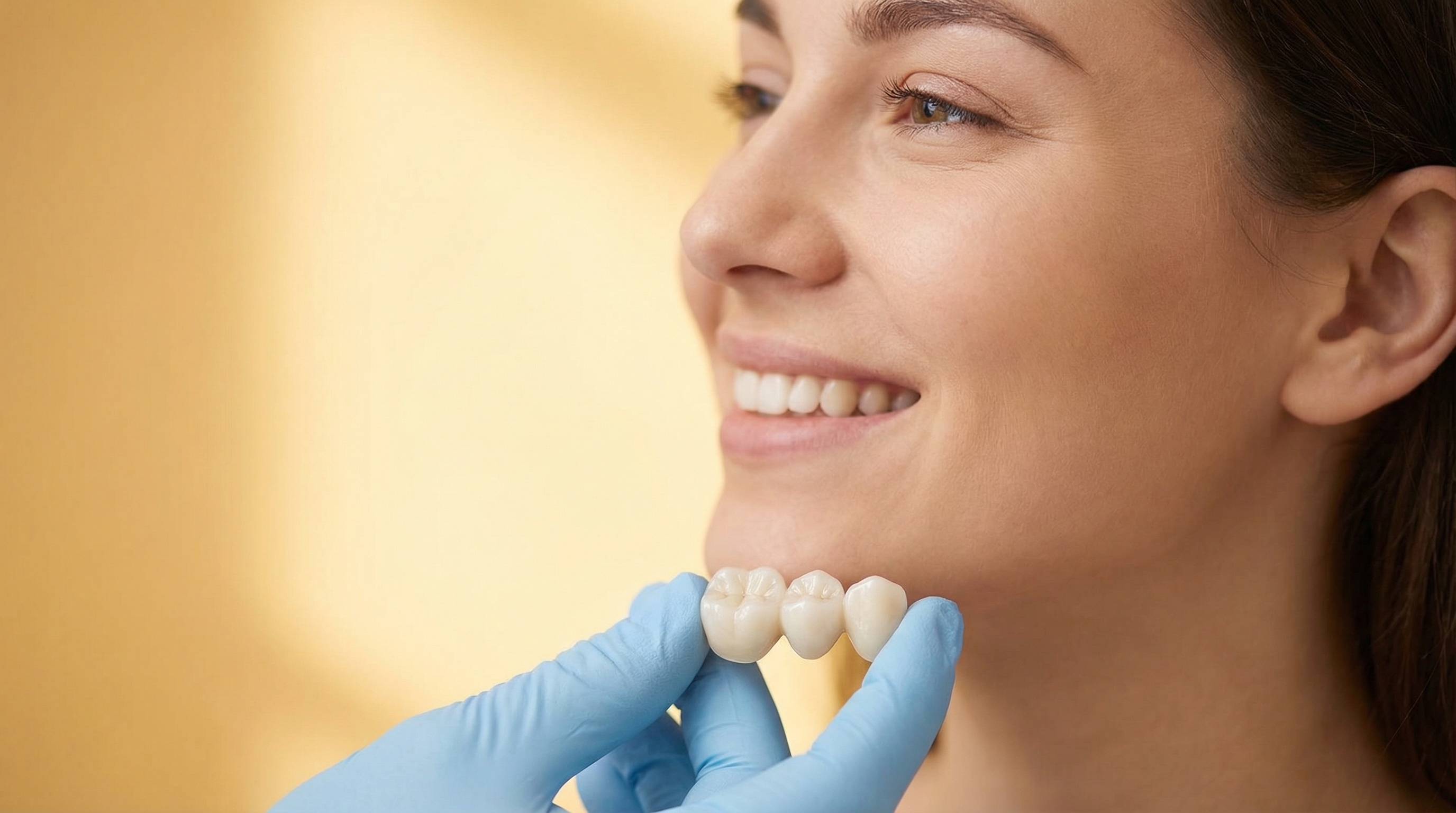
Types of Dental Bridges
Traditional Bridge
The most common type. Crowns are placed on both teeth adjacent to the gap, supporting a false tooth between them. Requires reshaping the abutment teeth to fit the crowns.
Maryland Bridge
A more conservative option. Uses a metal or porcelain framework bonded to the back of adjacent teeth — no crowns needed. Best for front teeth with light biting force.
The Process
Getting a bridge typically takes two visits over 2–3 weeks. At the first visit, your dentist prepares the abutment teeth by reshaping them, takes impressions, and places a temporary bridge. At the second visit, your custom permanent bridge is cemented into place. The entire process is done under local anesthesia with zero downtime.
Pros & Cons
Advantages
- No surgery required
- Completed in just 2–3 weeks
- Fixed in place — no removal needed
- Natural-looking porcelain materials
- Lower upfront cost than implants
- Covered by most dental insurance
Considerations
- Requires altering healthy adjacent teeth
- Does not prevent bone loss in the gap
- Typical lifespan of 7–15 years (vs. lifetime for implants)
- Flossing requires a threader or special brush
- If one supporting tooth fails, the entire bridge fails
Cost on Long Island
Bridge vs. Implant? If bone preservation matters to you and you want the longest-lasting solution, an implant is superior. But if you want a fast, non-surgical, insurance-friendly fix — especially for front teeth — a bridge is an excellent choice. Read our full bridge vs. implant comparison.
Implant-Supported Bridges
When you're missing several teeth in a row, placing an individual implant for each one isn't always necessary — or cost-effective. An implant-supported bridge uses just two implants as anchors to support a bridge of three or more connected teeth. This gives you the bone-preserving benefits of implants without the cost of placing one for every single missing tooth.
Unlike traditional bridges, implant bridges don't require altering healthy neighboring teeth. The implants serve as the anchors instead, leaving your natural teeth completely untouched.
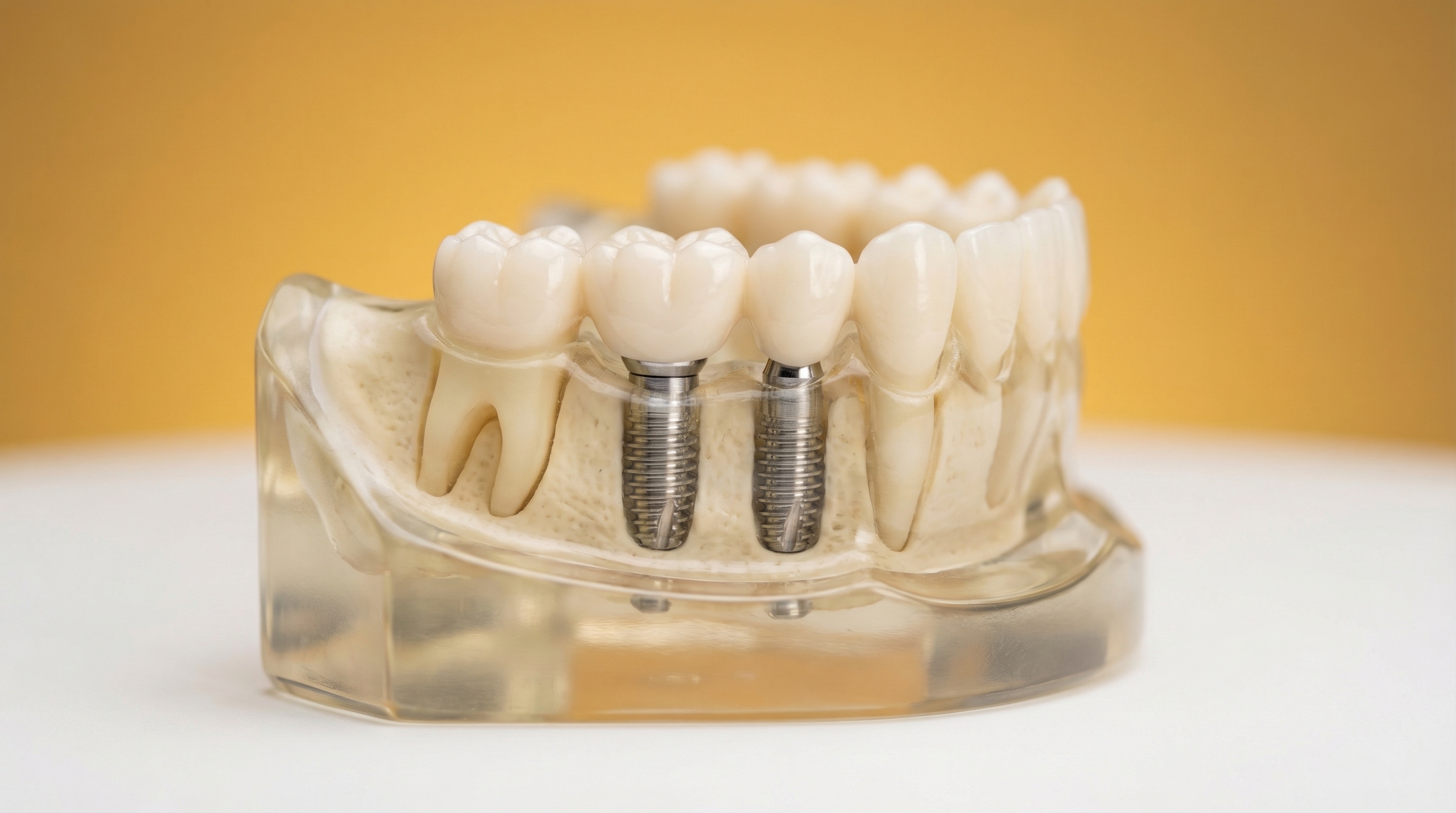
How It Works
Place Implants
Two titanium implants are surgically placed at either end of the gap using 3D-guided planning.
Heal & Integrate
Over 3–6 months, both implants fuse with the jawbone. A temporary bridge keeps you smiling during healing.
Attach Bridge
A custom porcelain bridge is permanently attached to the implants. No adhesive. No removal. Completely fixed.
Pros & Cons
Advantages
- Preserves jawbone at implant sites
- No damage to neighboring natural teeth
- More stable than traditional bridges
- Lasts 10–15+ years (often longer)
- Fewer implants needed than individual placement
- Fixed — feels and functions like natural teeth
Considerations
- Requires surgery for implant placement
- 3–6 month healing timeline
- Higher cost than traditional bridges
- Requires adequate bone (may need grafting)
- Bone loss may still occur under the pontic teeth
Cost on Long Island
Partial Dentures
If you're missing several teeth scattered across your mouth but still have a number of healthy natural teeth, a partial denture can fill in the gaps without surgery. It's a removable appliance — you take it out at night and for cleaning — that clips onto your remaining teeth to hold replacement teeth in position.
While not as permanent as implants or bridges, modern partials are far more comfortable, natural-looking, and well-fitting than the clunky "partial plates" of decades past. At Meadowbrook Dental Care, we use digital impressions and premium materials to create partials that patients actually enjoy wearing.
Types of Partial Dentures
Metal-Framework Partial
A cobalt-chrome framework with clasps that grip your natural teeth. Extremely durable and thin. The industry standard for decades. Some patients dislike the visible metal clasps.
Flexible Partial (Valplast)
Made from a flexible, translucent nylon material. No metal clasps — the gum-colored base blends invisibly. More comfortable and aesthetic but may be less durable long-term.
Pros & Cons
Advantages
- No surgery required
- Most affordable tooth replacement option
- Quick to fabricate (usually 2–4 weeks)
- Prevents remaining teeth from shifting
- Easy to repair or add teeth later
- Covered by most dental insurance
Considerations
- Removable — must be taken out nightly
- Does not prevent bone loss
- Less stable than fixed options
- Clasps may be visible (metal type)
- Requires adjustment period to get used to
- Needs relining every few years as bone changes
Cost on Long Island
Think of partials as a stepping stone. Many patients start with a partial denture to restore function and appearance right away, then transition to dental implants or an implant-supported solution when budget and timing allow. There's no wrong path — only the one that works for you right now.
Full Dentures
If you've lost all your teeth in an upper or lower arch — or need remaining damaged teeth extracted — full dentures provide a complete set of replacement teeth. Today's dentures are nothing like the bulky "false teeth" of the past. At Meadowbrook Dental Care, we use modern materials and precise digital imaging to create dentures that look remarkably natural and fit comfortably from day one.
Types of Full Dentures
Conventional Full Dentures
Placed 8–12 weeks after all teeth are removed and gums have fully healed. This allows for the most precise fit. You'll be without teeth during the healing period unless you use a temporary set.
Immediate Dentures
Pre-made before your extractions and placed the same day teeth are removed. You never go a single day without teeth. Requires relining as gums heal and change shape.
Common Questions
Not at all. We customize the gum color, tooth translucency, and tooth shape to match your facial features. Most people will never know you're wearing dentures. Our team takes pride in creating results that look completely natural.
Upper dentures use suction against the roof of your mouth. Lower dentures rely on the ridge of your jaw and the muscles of your mouth. If you struggle with stability, implant-supported dentures eliminate slipping entirely.
There's a learning curve — start with soft foods and work your way up. Traditional dentures restore about 25% of natural bite force. For full bite strength, implant-supported options are significantly better.
With proper care, dentures last 5–7 years before needing replacement. Your jawbone changes shape over time (since there are no roots stimulating it), so periodic relining is necessary to maintain a proper fit.
Pros & Cons
Advantages
- Restores a complete smile immediately
- No surgery required
- Most affordable full-arch solution
- Modern dentures look very natural
- Supports facial structure
- Immediate dentures = no day without teeth
Considerations
- Removable — taken out for cleaning and sleep
- Does not prevent ongoing bone loss
- Reduced bite force (~25% of natural)
- May slip or require adhesive (lower dentures especially)
- Must be replaced every 5–7 years
- Food restrictions (hard, sticky foods)
Cost on Long Island
Implant-Supported Dentures
If you love the idea of dentures but hate the thought of slipping, adhesive, and sore spots — implant-supported dentures are the answer. By anchoring your denture to 2–6 strategically placed dental implants, you get a denture that clicks securely into place, stays put while you eat and talk, and can be removed for easy cleaning.
This is one of the most popular solutions we provide at Meadowbrook — it combines the affordability of dentures with the stability of implants, and patients consistently tell us it's the treatment that changed their life.
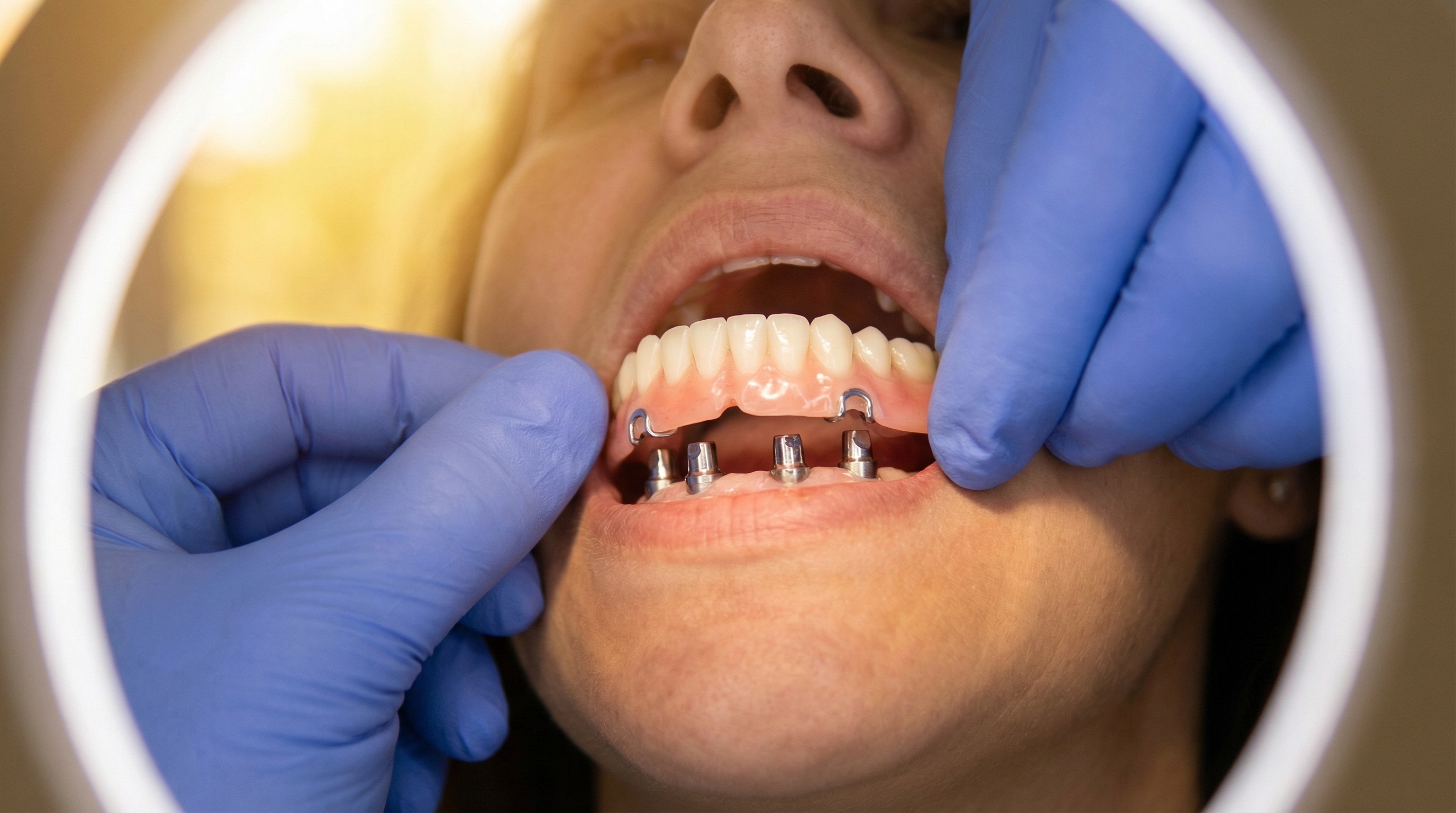
Snap-In vs. Fixed Hybrid: What's the Difference?
Snap-In Overdenture
Clicks onto 2–4 implants using locator attachments. You remove it nightly for cleaning. The most cost-effective implant-denture option.
- 2–4 implants per arch
- Removable for cleaning
- Lower cost than fixed
- Easy to maintain and repair
- Restores ~60% bite force
Fixed Hybrid Prosthetic
Permanently screwed onto 4–6 implants. Only your dentist can remove it. Functions virtually identically to natural teeth. This is the premium option.
- 4–6 implants per arch
- Permanently fixed in place
- Brush and floss like natural teeth
- Highest stability and comfort
- Restores ~90% bite force
Not sure which type is right for you? The choice often comes down to budget, bone availability, and personal preference. Our doctors — including Dr. Miguel Casañas and Dr. Bryan Tamburro — will evaluate your specific situation and recommend the best path forward.
Pros & Cons
Advantages
- Dramatically more stable than conventional dentures
- No adhesive or messy creams ever again
- Preserves jawbone at implant sites
- Eat steak, apples, corn — almost anything
- Restores confidence in speaking and laughing
- Snap-in version is easy to clean
Considerations
- Requires implant surgery
- Higher cost than conventional dentures
- 3–6 month healing period for implants
- Snap-in type still needs daily removal
- Fixed type requires professional cleaning visits
- May require bone grafting if bone is insufficient
Cost on Long Island
Tired of Dentures That Slip?
Implant-supported dentures can transform your daily life. Our team will show you exactly what's possible at your free consultation — including a side-by-side comparison of snap-in vs. fixed options for your specific case.
Schedule Your Free ConsultationAll-on-4 & All-on-6 Full Arch Implants
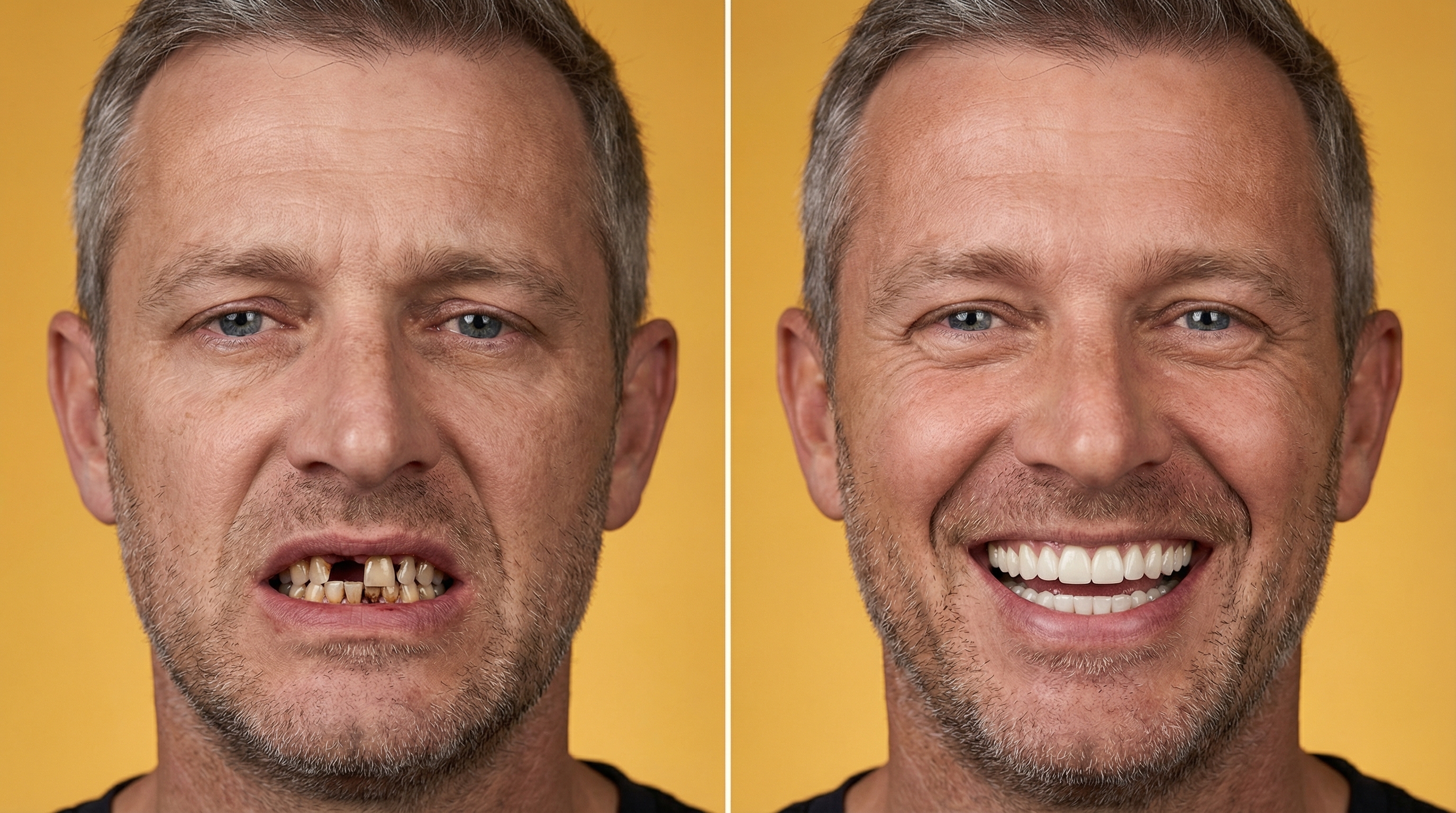
If you're missing most or all of your teeth and want a permanent, fixed, non-removable solution, All-on-4 dental implants represent one of the most transformative procedures in modern dentistry. Using just four to six strategically placed implants, your dentist can support an entire arch of beautiful, fixed teeth — often placed the same day as surgery.
This isn't a denture you take out. It's a permanently fixed prosthetic that looks, feels, and functions like a full set of natural teeth. Patients routinely describe their All-on-4 treatment as life-changing.
Why This Procedure Is Revolutionary
Same-Day Teeth
Walk in with failing teeth, walk out with a brand new smile — all in one appointment.
No Bone Grafting
Angled rear implants bypass areas of bone loss, making this option viable even for patients told they "can't have implants."
Permanent & Fixed
No removal. No adhesive. Brush and floss like natural teeth. Restores ~90% of natural bite force.
The All-on-4 Process
1. 3D Scan & Treatment Planning
A CBCT scan maps your jawbone in detail. Your implant team plans exact placement angles using digital surgical guides.
2. Extractions & Implant Placement
Any remaining teeth are extracted. Four to six implants are placed under sedation. Two rear implants are angled at 30–45° to maximize bone contact.
3. Temporary Teeth — Same Day
A pre-fabricated temporary prosthetic is attached to the implants before you leave. You walk out smiling and able to eat soft foods immediately.
4. Final Prosthetic (3–6 Months)
After your implants fully integrate with the bone, your permanent custom prosthetic is fabricated and attached — this is your final, long-term smile.
All-on-4 vs. All-on-6
4 Implants Per Arch
The standard protocol. Ideal for patients with moderate bone loss. Two straight front implants, two angled rear implants.
- Fewer implants = lower cost
- Often avoids bone grafting entirely
- Proven 20+ year track record
- Best for: Most full-arch cases
6 Implants Per Arch
Additional implants for maximum support. Recommended for patients with stronger bone who want extra security and load distribution.
- More support points = more stability
- Better load distribution across the arch
- Ideal for heavier bite force patients
- Best for: Patients with adequate bone
Cost on Long Island
Ready for a New Smile in One Day?
All-on-4 is the most life-changing procedure we perform. Schedule your free 3D scan and consultation to see if you're a candidate.
Book Your All-on-4 ConsultationFull Mouth Reconstruction
A full mouth reconstruction isn't a single procedure — it's a comprehensive, customized treatment plan that combines multiple restorative and cosmetic procedures to completely rebuild your mouth. This is the path for patients whose dental needs go beyond what any single option can solve: extensive decay, multiple missing teeth, bite problems, worn teeth from grinding, and failed previous dental work.
At Meadowbrook Dental Care, our multi-specialty team collaborates to design a phased plan that addresses every issue systematically — restoring function, aesthetics, and long-term health.
Who Needs Full Mouth Reconstruction?
Multiple Missing Teeth
Scattered gaps across both arches requiring a combination of implants, bridges, and other restorations.
Severe Decay or Damage
Teeth broken down beyond simple fillings. Multiple teeth need crowns, root canals, or extraction.
Bite & TMJ Problems
Chronic jaw pain, uneven bite, or TMJ disorders requiring comprehensive realignment.
Worn or Ground-Down Teeth
Years of bruxism (grinding) have shortened teeth, eroded enamel, and changed the bite relationship.
What It May Include
Typical Timeline
Phased Treatment Plan
Cost on Long Island
Full mouth reconstruction is not something you should shop for on price alone. The skill of your dental team, the quality of materials, and the comprehensiveness of the plan are what determine whether your results last 5 years or 25. At Meadowbrook, you get a team of specialists — Dr. Brian Cruz, Dr. Miguel Casañas, Dr. Bryan Tamburro, and Dr. Daniela Rendon — working together under one roof.
Master Comparison Table
Every tooth replacement option side by side. Use this to narrow down which solutions deserve a deeper conversation with your dentist.
| Option | Best For | Surgery? | Fixed? | Prevents Bone Loss? | Lifespan | Cost/Arch (LI) |
|---|---|---|---|---|---|---|
| Single Implant | 1 tooth | Minor | ✓ Yes | ✓ Yes | Lifetime | $3K–$6K |
| Dental Bridge | 1–3 teeth | ✓ No | ✓ Yes | ✗ No | 7–15 years | $2K–$5K |
| Implant Bridge | 2–5 teeth | Minor | ✓ Yes | Partial | 10–15+ years | $6K–$12K |
| Partial Denture | Multiple gaps | ✓ No | ✗ Removable | ✗ No | 5–7 years | $800–$3K |
| Full Denture | All teeth | ✓ No | ✗ Removable | ✗ No | 5–7 years | $1.5K–$4K |
| Snap-In Denture | Full arch | Minor | Snap-in | Partial | 10–15 years | $8K–$15K |
| All-on-4 | Full arch | Yes | ✓ Yes | ✓ Yes | 20+ years | $20K–$35K |
| Full Mouth Recon | Complex cases | Varies | ✓ Yes | ✓ Yes | 15+ years | $15K–$80K+ |
Important: These are estimated ranges based on typical Long Island pricing as of 2026. Your actual cost depends on your specific clinical situation, bone health, number of teeth involved, and materials chosen. The only way to get an accurate quote is a clinical exam with imaging. At Meadowbrook, your first consultation includes a 3D scan and personalized treatment plan at no obligation.
Not Sure Which Option Is Right for You?
Bring this guide to your consultation. Our doctors will review it with you, answer your questions, and recommend the best path based on your unique situation — not a one-size-fits-all approach.
Get Your Personalized RecommendationWhat If I've Been Told I Have Bone Loss?
This is one of the most common concerns we hear from patients: "Another dentist told me I don't have enough bone for implants." While that may have been true in the past, advances in bone grafting, implant design, and surgical technique mean the vast majority of patients CAN receive implants — even after significant bone loss.
At Meadowbrook Dental Care, we successfully place implants for patients who were turned away by other offices. If you've been told "no," get a second opinion with our team before giving up on implants.
Your Options When Bone Is Insufficient
Socket Preservation
Done immediately after a tooth extraction. Grafting material fills the empty socket to prevent bone collapse. This preserves the site perfectly for a future implant.
Ridge Augmentation
Rebuilds the height and width of your jawbone ridge when bone has already been lost. Creates the solid foundation needed for implant placement. Learn more.
Sinus Lift
For upper back teeth where the sinus cavity sits too low. The sinus floor is gently elevated and bone graft material placed beneath it, creating enough bone height for implants.
Zygomatic Implants
Extra-long implants that anchor into the cheekbone (zygoma) instead of the jawbone. Completely bypasses the need for bone grafting in severe cases. Learn more.
The Bone Grafting Process
1. 3D Assessment
A CBCT scan precisely measures your existing bone volume and density. This determines exactly what type and amount of grafting you need.
2. Grafting Procedure
Sterile, biocompatible grafting material is placed in the deficient area under local anesthesia. The material acts as a scaffold that encourages your body to grow new, natural bone.
3. Healing Period
The graft integrates over 4–9 months as your body replaces the scaffold with strong, living bone. This is the critical foundation-building phase.
4. Implant Placement
Once the new bone is mature and solid, implants are placed with confidence. The same team at Meadowbrook handles both your graft and your implant — seamless care under one roof.
Don't let bone loss stop you. Between grafting, sinus lifts, zygomatic implants, and the All-on-4 technique (which often avoids grafting entirely), there is almost always a path to implants. The only way to know your options is a free 3D scan and consultation with our surgical team.
Cost & Financing on Long Island
We understand that cost is often the biggest concern when considering tooth replacement — and we believe financial barriers should never prevent you from getting the care you need. At Meadowbrook, we work with every patient to find a payment path that fits their budget.
How to Pay for Treatment
Dental Insurance
We accept most major PPO plans. Our front desk verifies your benefits before treatment so you know exactly what's covered. Many procedures qualify for 50–80% coverage. See accepted plans.
CareCredit Financing
0% interest for 12–24 months on qualifying purchases. Longer terms available at low rates. Apply in minutes right in our office. Apply now.
Dental Savings Plan
No insurance? Our in-house membership plan offers significant discounts on all services — including implants. No deductibles, no waiting periods, no annual maximums. Learn more.
HSA / FSA
Use pre-tax dollars from your Health Savings Account or Flexible Spending Account. Dental implants and restorations typically qualify. HSA/FSA details.
Quick Cost Reference
Estimated Costs on Long Island (2026)
Money-Saving Tips
We never want cost to be the reason you don't get treated. Our financial coordinators will sit with you, review your insurance, explain every financing option, and build a payment plan that works before you commit to anything. Schedule your free consultation to get your personalized cost estimate.
Start Your Dental Journey with us
Seamless Appointments
Expert Dentist
Call Today