
A missing front tooth changes everything. It affects the way you smile, the way you speak, and—for many people—the way you feel about yourself in social and professional settings. Unlike a missing molar that nobody sees, a gap in your front teeth is on display every time you open your mouth.
The good news is that modern dentistry offers multiple reliable ways to replace a front tooth, from permanent implants to conservative bonded bridges. The right choice depends on your anatomy, timeline, aesthetic goals, and budget. This guide walks through the five best options available in 2026 so you can have an informed conversation with your dentist. If you are in Nassau County or anywhere on Long Island, Meadowbrook Dental Care in Mineola and Plainview provides all of the solutions discussed below.
Why Replacing a Front Tooth Is Different
The front teeth live in what dentists call the "aesthetic zone"—the six to eight upper and lower teeth that are visible when you smile and talk. Replacing a tooth in this area demands a higher level of precision than replacing a back molar, because even small differences in shade, shape, gum contour, or alignment are immediately noticeable.
Beyond cosmetics, a missing front tooth affects phonetics. The upper front teeth play a direct role in producing "F," "V," "TH," and "S" sounds. Patients with a gap often unconsciously adjust their tongue placement, which can lead to a subtle but noticeable change in speech. And from a structural standpoint, the remaining teeth can begin to shift into the open space over time, altering your bite and creating new problems.
Option 1: Single Dental Implant (The Gold Standard)
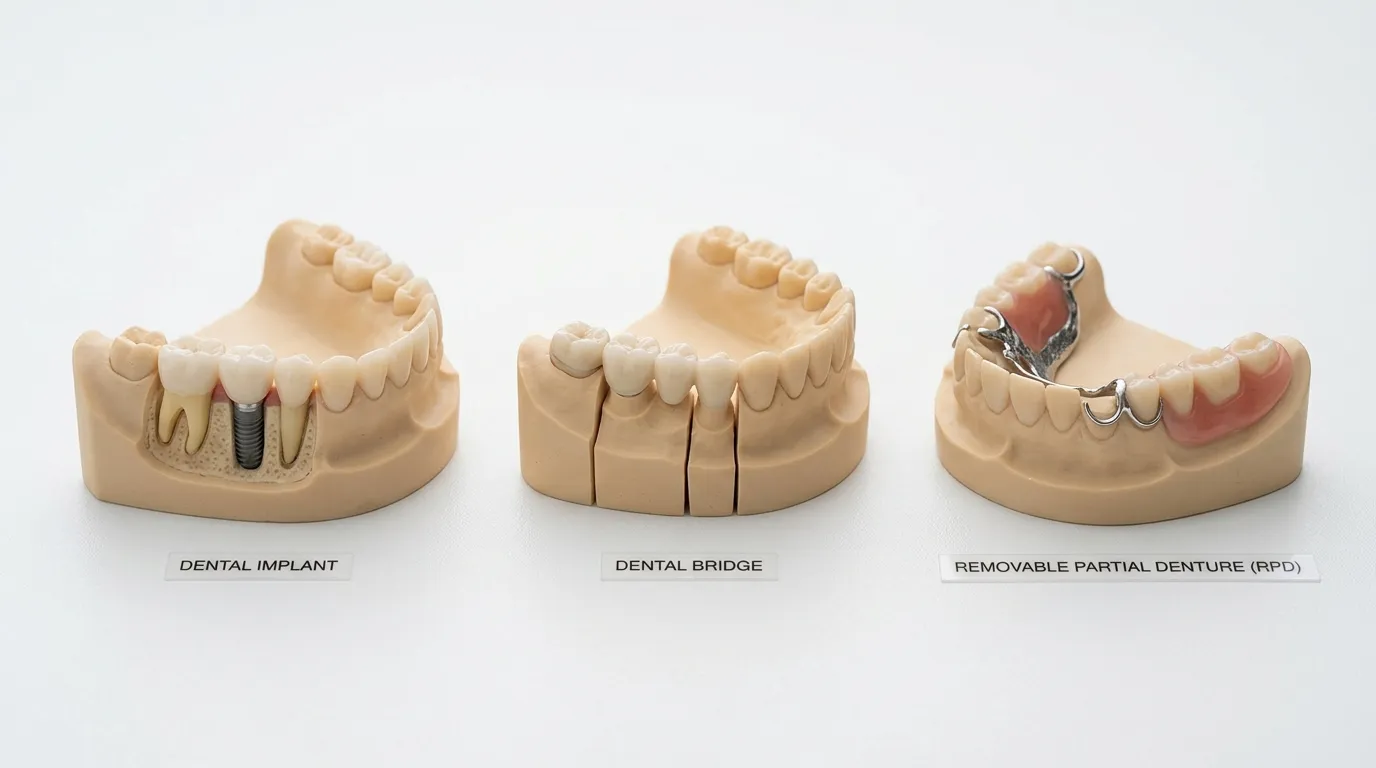
A dental implant replaces the entire tooth—root and all. A small titanium or zirconia post is surgically placed into the jawbone, where it fuses with the bone over three to six months through a process called osseointegration. Once healed, a custom porcelain or zirconia crown is attached to the implant via an abutment, creating a restoration that looks, feels, and functions like a natural tooth.
For front teeth, implants offer several critical advantages. They preserve jawbone volume—without a root in place, the bone beneath a missing tooth gradually resorbs, which can cause the gum line to recede and create an uneven appearance. Implants also do not require any modification of adjacent healthy teeth, unlike bridges. With proper care, a front-tooth implant can last 20 years or longer.
- Timeline: 3–6 months total (a temporary tooth is worn during healing so you are never without a front tooth).
- Cost range: $3,000–$5,500 on Long Island, including the implant, abutment, and crown. Bone grafting, if needed, adds $300–$800.
- Best for: Patients who want the most natural, long-lasting result and have adequate bone density (or are candidates for grafting).
Cost varies based on imaging, grafting needs, and materials. A consultation is the only way to receive a precise estimate.
Option 2: Traditional Dental Bridge
A traditional bridge replaces one or more missing teeth by anchoring a false tooth (pontic) to crowns placed on the adjacent teeth. The two neighboring teeth are reshaped (reduced) to accommodate the crowns, and the entire unit—two crowns plus the pontic—is cemented permanently in place.
Bridges are a proven, time-tested solution that can deliver excellent aesthetics in the front of the mouth, especially when fabricated from all-ceramic materials. The treatment is faster than an implant— typically completed in two to three visits over two to three weeks— because no surgical healing period is required.
- Timeline: 2–3 weeks from start to cementation.
- Cost range: $2,500–$5,000 for a three-unit bridge (two crowns + one pontic).
- Trade-off: The two adjacent teeth must be ground down to serve as anchors, which permanently alters healthy tooth structure.
- Longevity: 10–15 years with proper care; may need replacement over a lifetime.
Option 3: Maryland (Resin-Bonded) Bridge
A Maryland bridge takes a more conservative approach than a traditional bridge. Instead of placing full crowns on the adjacent teeth, it uses thin metal or ceramic "wings" that are bonded to the back surfaces of the neighboring teeth with dental adhesive. The wings are invisible from the front, so the result looks natural without requiring any significant reshaping of healthy enamel.
Maryland bridges work particularly well for younger patients whose jawbones are still developing and who may not yet be candidates for implants. They are also a good option when the adjacent teeth are healthy and the patient prefers to avoid grinding them down. The downside is durability—the adhesive bond is not as strong as a cemented crown, so Maryland bridges can debond under heavy biting forces. For a front tooth that does not bear significant chewing load, however, this is often a non-issue.
- Timeline: 2–3 visits over 2–3 weeks.
- Cost range: $1,500–$3,500.
- Best for: Younger patients, patients who want to preserve adjacent tooth structure, and cases where the missing tooth does not bear heavy biting forces.
Option 4: Removable Partial Denture ("Flipper")
A flipper is a lightweight, removable acrylic partial denture that holds a single replacement tooth. It clips onto adjacent teeth or rests on the gum tissue and palate. Flippers are the most affordable tooth-replacement option and can be fabricated quickly—sometimes in as little as one day in an emergency situation.
Most dentists consider a flipper a temporary or transitional solution rather than a permanent one. It is commonly used to fill the gap while a patient waits for an implant to heal or saves for a more definitive restoration. Flippers must be removed at night for cleaning, and they can feel bulky. Over time, the acrylic base can irritate the gum tissue, and the clasps may loosen.
- Timeline: 1–7 days for fabrication.
- Cost range: $300–$800.
- Best for: Temporary use while waiting for a permanent solution; patients on a very tight budget who need immediate aesthetics.
Option 5: Implant-Supported Bridge
When two or more adjacent front teeth are missing, an implant-supported bridge provides a fixed, permanent solution without requiring an implant for every missing tooth. Two implants are placed at the ends of the gap, and a multi-tooth bridge is secured onto them. This distributes the chewing load across the implants and preserves bone in the area.
For patients missing three or four front teeth, this approach is often more cost-effective and less invasive than placing individual implants for each tooth. The aesthetic results in the front of the mouth can be outstanding, especially when combined with custom gum contouring and shade-matched porcelain. Learn more about implant options on our dental implants page.
- Timeline: 4–6 months (similar to single implants).
- Cost range: $6,000–$12,000 depending on the number of teeth replaced and grafting needs.
- Best for: Patients missing 2+ adjacent front teeth who want a fixed, permanent restoration.
Comparing All Five Options
The table below puts the key differences side by side. Use it as a starting point for your conversation with your dentist—your specific anatomy, bone density, and goals will determine which option is truly the best fit.
| Option | Best For | Timeline | Cost Range | Bone Preservation | Longevity |
|---|---|---|---|---|---|
| Single implant | Long-term, most natural result | 3–6 months | $3,000–$5,500 | Yes | 20+ years |
| Traditional bridge | Faster fixed option; no surgery | 2–3 weeks | $2,500–$5,000 | No | 10–15 years |
| Maryland bridge | Conservative; younger patients | 2–3 weeks | $1,500–$3,500 | No | 5–10 years |
| Flipper (removable) | Temporary; tight budget | 1–7 days | $300–$800 | No | 1–3 years |
| Implant-supported bridge | 2+ missing front teeth | 4–6 months | $6,000–$12,000 | Yes | 20+ years |
Costs reflect typical ranges in the Nassau County / Long Island market as of 2026 and include the restoration. Actual pricing depends on imaging, grafting, materials, and individual case complexity.
How Digital Smile Design Helps You Choose
One of the biggest anxieties patients have about front-tooth replacement is not knowing what the final result will look like. At Meadowbrook Dental Care, we use Digital Smile Design to address that uncertainty. Using high-resolution photos, digital scans, and specialized software, we create a visual preview of your restored smile before any treatment begins.
This lets you see how different options—an implant versus a bridge, for example—will look in your mouth, factoring in your facial proportions, lip line, and gum contours. You can request adjustments to shape, shade, and alignment before anything is fabricated, giving you confidence and control over the outcome.
Choosing the Right Option: Aesthetics vs. Function vs. Budget
There is no single "best" option—only the best option for your specific situation. Here is a simple framework to guide your thinking:
- If aesthetics and longevity are your top priority: A single dental implant offers the most natural look and feel, preserves bone, and lasts decades.
- If you need a fixed solution quickly: A traditional or Maryland bridge can be completed in weeks, with no surgical healing period.
- If budget is the primary constraint: A flipper provides an immediate, affordable temporary fix while you explore financing for a permanent restoration.
- If multiple front teeth are missing: An implant-supported bridge combines the bone-preserving benefits of implants with the efficiency of replacing multiple teeth on fewer posts.
Many patients start with a flipper or temporary bridge while they plan and finance an implant. This phased approach lets you restore your appearance immediately and invest in the long-term solution on your own timeline. Meadowbrook offers comprehensive cosmetic dentistry so all of these options—and combinations of them—are available under one roof.
Frequently Asked Questions
How long can I go without replacing a missing front tooth?
There is no hard deadline, but delaying replacement has consequences. Bone loss begins within weeks of extraction and accelerates over the first year. Adjacent teeth can start shifting into the gap within months, potentially complicating future treatment. The sooner you replace a front tooth, the simpler and more predictable the outcome.
Will insurance cover a front tooth replacement?
Most dental PPO plans cover a portion of bridges and, increasingly, dental implants—though coverage levels vary widely. Implants may be covered at 50% after deductible; bridges are often covered at 50–80%. Flippers are usually covered as a temporary prosthetic. Contact your insurer or ask your dental office to run a pre-authorization to find out your specific benefit.
Can I get a dental implant the same day a front tooth is extracted?
In some cases, yes. Immediate implant placement—where the implant is placed directly into the extraction socket—can shorten the overall timeline and preserve bone. However, this requires adequate bone volume and no active infection. Your dentist will determine whether you are a candidate after a thorough evaluation with 3D imaging.
What is the most natural-looking front tooth replacement?
A single dental implant with a custom zirconia or porcelain crown generally provides the most lifelike result. Because the crown is individually shaped, shaded, and contoured to match your adjacent teeth—and because the implant maintains the bone and gum tissue—the final restoration is virtually indistinguishable from a natural tooth.
How much does it cost to replace a front tooth on Long Island?
Costs range from $300 for a basic flipper to $5,500 for a single implant with a custom crown. The table in this article provides detailed ranges for each option. For a personalized quote, schedule a consultation—Meadowbrook Dental Care provides transparent, itemized treatment plans so you know exactly what to expect. Read more about dental implant costs on Long Island.
Ready to explore your front tooth replacement options? Call (516) 284-1234 (Mineola) or (516) 346-5757 (Plainview), or schedule your consultation online.
Restore Your Smile with Confidence
Dr. Casañas and the team at Meadowbrook Dental Care specialize in front-tooth replacement using dental implants, bridges, and Digital Smile Design. Schedule a consultation at our Mineola or Plainview office.