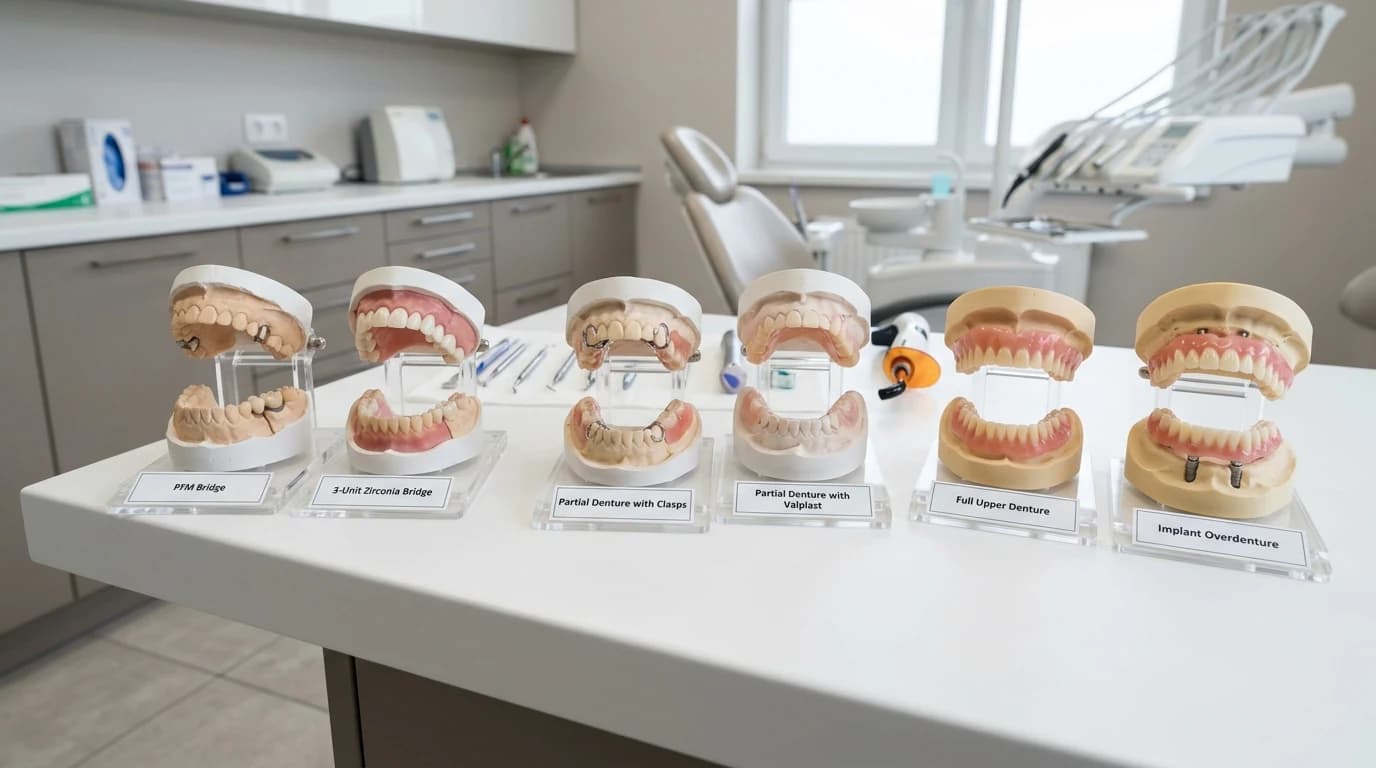
Missing teeth affect far more than your appearance. Every gap in your smile creates a chain reaction: neighboring teeth drift, your bite changes, jawbone deteriorates, and the remaining teeth bear disproportionate force that accelerates wear and fracture. The good news is that modern restorative dentistry offers multiple proven paths to rebuild your smile—each with distinct advantages depending on your anatomy, health, lifestyle, and budget.
At Meadowbrook Dental Care in Mineola and Plainview, we see patients across Long Island who are weighing these options. This guide walks through each one honestly—what it does well, where it falls short, and who it is best suited for—so you can have a more productive conversation with your dentist.
Nothing in this article replaces a clinical exam. Use it to understand the landscape, then let your care team match the right solution to your specific situation.
Dental Implants: The Gold Standard for Tooth Replacement
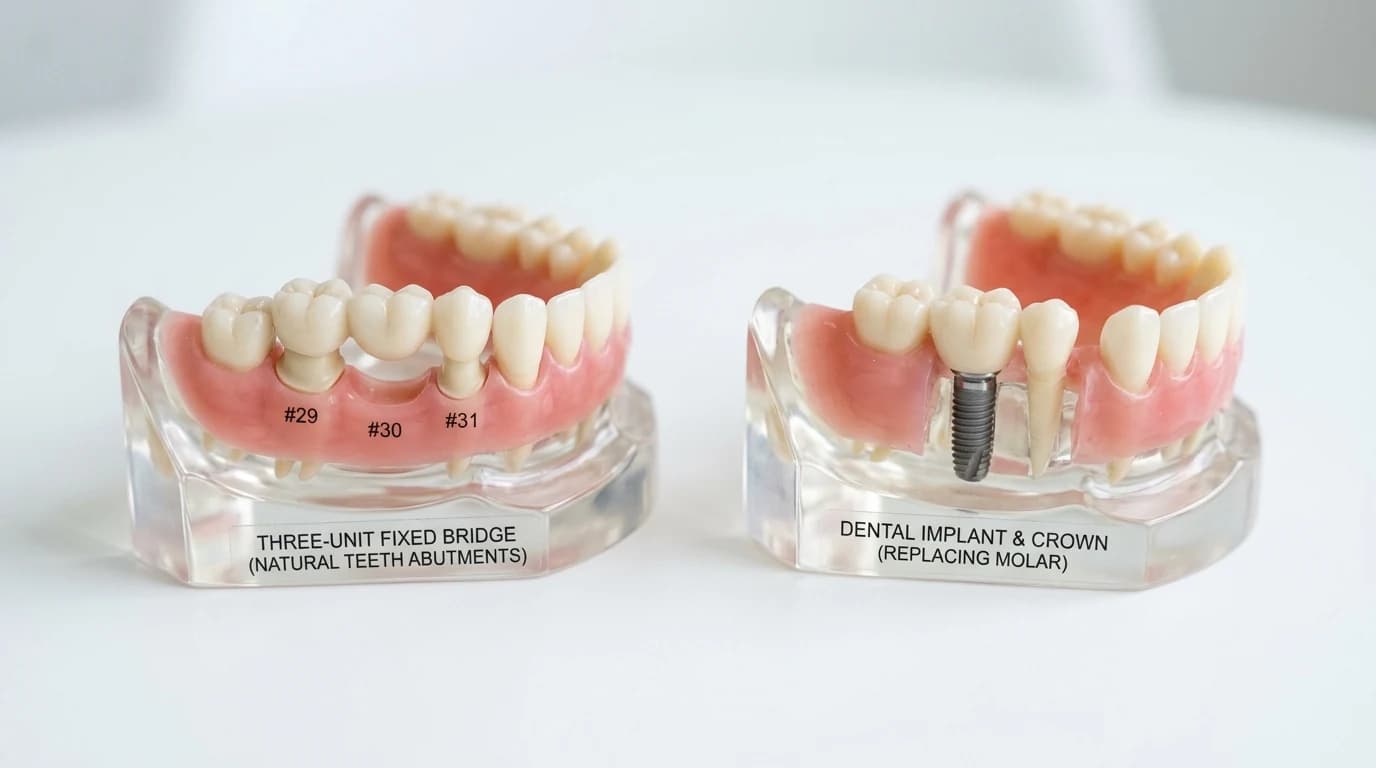
Dental implants replace the entire tooth—root and crown—by placing a titanium or zirconia post into the jawbone and topping it with a custom restoration. Through a process called osseointegration, the implant fuses with bone tissue over 3–6 months, creating a foundation as stable as a natural root.
Implants are suitable for replacing a single tooth, several teeth (using implant-supported bridges), or an entire arch. They are the only restorative option that preserves jawbone density, which prevents the sunken facial appearance that commonly follows tooth loss. Success rates in the published literature consistently fall between 95% and 98% at 10 years for well-selected cases.
- Best for: Patients with adequate bone (or candidates for grafting) who want a permanent, low-maintenance solution that protects long-term oral health.
- Typical cost on Long Island: $3,000–$5,500 per single implant; $6,000–$12,000 for an implant-supported bridge.
- Lifespan: Implant post can last 25+ years; crown typically 10–15 years.
All-on-4 Full-Arch Implant Treatment
For patients missing most or all teeth in one or both jaws, All-on-4 treatment provides a complete set of fixed teeth supported by just four strategically placed implants per arch. Two implants are placed vertically in the front of the jaw where bone is naturally dense, and two are angled at up to 45 degrees in the back to maximize contact with available bone—often eliminating the need for bone grafting.
Patients typically receive a temporary set of teeth on the same day as surgery, transitioning to a final zirconia or acrylic prosthesis 4–6 months later. This approach has transformed the lives of denture wearers across Nassau County who are tired of adhesives, slipping, and restricted diets.
- Best for: Patients with failing or missing teeth across an entire arch who want fixed, non-removable teeth without grafting delays.
- Typical cost: $20,000–$30,000 per arch.
- Lifespan: Implant posts can last a lifetime; prosthesis may need refurbishment at 10–15 years.
Traditional Fixed Bridges
A traditional bridge replaces one or more missing teeth by anchoring a pontic (artificial tooth) to crowns cemented onto the natural teeth on either side of the gap. It is a time-tested solution that can be completed in two to three visits over a few weeks, making it faster than implants.
The main drawback is that the two adjacent anchor teeth must be permanently reduced (ground down) to accept crowns, even if they are perfectly healthy. This increases their long-term risk of decay and fracture. Additionally, because no root replacement is placed in the bone, the jawbone beneath the pontic continues to resorb over time.
- Best for: Patients who are not candidates for implants or prefer a faster, non-surgical option for one to three adjacent missing teeth.
- Typical cost: $2,500–$5,000 for a three-unit bridge.
- Lifespan: 7–15 years before replacement.
Partial Dentures
A removable partial denture replaces one or more teeth using a framework of acrylic or metal with clasps that hook onto remaining natural teeth. Modern partial dentures are lighter and more aesthetically refined than older designs, and flexible materials like Valplast eliminate visible metal clasps for many patients.
Partials are generally the most affordable option, and they can be fabricated quickly. However, they require removal for cleaning, can shift during eating, and do not stimulate the jawbone. The clasps may place lateral stress on anchor teeth, increasing their risk of loosening over time. Many patients use partials as a transitional solution while saving for implants.
Full Dentures
Conventional full dentures replace all teeth in an arch using an acrylic base that rests on the gum tissue. Upper dentures typically fit more securely because the palate provides suction, while lower dentures are notoriously less stable because the tongue and floor of the mouth displace them.
Dentures require periodic relining (every 2–3 years) as the underlying bone continues to resorb, and most dentures need full replacement every 5–8 years. Patients who struggle with lower denture stability often benefit from upgrading to an implant-retained overdenture, which snaps onto two to four implants for dramatically improved retention while still being removable for cleaning.
Comparison: All Restorative Options at a Glance
The following table compares the major tooth replacement options across the criteria that matter most. Use it as a reference, but remember that individual factors—bone quality, gum health, medical history—ultimately determine which option is right for you.
| Option | Best For | Longevity | Cost Range | Bone Preservation |
|---|---|---|---|---|
| Single dental implant | One missing tooth | 25+ years (post) | $3,000–$5,500 | Yes |
| Implant-supported bridge | 3–4 adjacent teeth | 15–25 years | $6,000–$12,000 | Yes (at implant sites) |
| All-on-4 full arch | Full arch replacement | 15–25+ years | $20,000–$30,000/arch | Yes |
| Traditional bridge | 1–3 teeth, non-surgical | 7–15 years | $2,500–$5,000 | No |
| Partial denture | Multiple teeth, budget | 5–8 years | $1,000–$3,000 | No |
| Full denture | Full arch, budget | 5–8 years | $1,500–$4,000/arch | No |
| Implant overdenture | Full arch, improved fit | 10–20 years | $8,000–$15,000/arch | Partial |
Disclaimer: Cost ranges are educational estimates for the Long Island area and are not a formal quote. Actual fees depend on clinical findings, materials, and additional procedures. A personalized treatment plan requires an in-person evaluation.
How to Choose the Right Option
There is no single “best” tooth replacement—only the best option for your specific situation. Here are the key factors your dentist will evaluate:
- Number and location of missing teeth: A single molar gap calls for a different approach than an entire upper arch.
- Bone volume and gum health: Adequate bone is essential for implants; grafting can rebuild it, but that adds time and cost.
- Medical history: Conditions like uncontrolled diabetes, immune disorders, or certain medications may affect healing and candidacy for surgical options.
- Budget and timeline: Implants offer the best long-term value but require a larger upfront investment. Dentures and bridges can be completed faster and at lower initial cost. Our implant cost guide covers financing options in detail.
- Lifestyle preferences: Some patients strongly prefer fixed (non-removable) teeth; others are comfortable with removable options.
Meadowbrook's In-House Advantage
One of the advantages of choosing Meadowbrook Dental Care for restorative work is our in-house digital workflow. We use 3D cone-beam CT imaging for precise diagnosis, digital impressions for comfortable scanning (no goopy molds), and computer-guided implant placement for predictable results.
For crowns and bridges, our digital design process speeds turnaround and ensures a precise fit—reducing adjustments and extra visits. When complex cases call for multiple specialties, full-mouth reconstruction planning keeps every element coordinated under one roof.
Frequently Asked Questions
What is the best option for replacing a single missing tooth?
For most patients, a dental implant is the preferred solution for a single missing tooth because it preserves bone, does not alter adjacent teeth, and offers the longest lifespan. If implant placement is not feasible due to bone loss or medical factors, a three-unit fixed bridge or a resin-bonded (Maryland) bridge may be recommended as alternatives.
Can I replace all my teeth without removable dentures?
Yes. All-on-4 and similar full-arch implant protocols provide a complete set of fixed, non-removable teeth supported by four to six implants per arch. These teeth are permanently attached and function like natural teeth—you brush them in your mouth and never take them out.
How do I know if I have enough bone for implants?
A 3D cone-beam CT scan reveals the exact height, width, and density of your jawbone at each potential implant site. If bone is insufficient, grafting procedures can rebuild it over 3–6 months. All-on-4 treatment is specifically designed to work with less bone by angling the posterior implants to engage denser areas of the jaw.
How long does restorative treatment take?
Timelines vary widely. A traditional bridge can be completed in 2–3 weeks. A single implant typically takes 3–6 months (including healing). All-on-4 patients receive temporary teeth the same day as surgery and a final prosthesis 4–6 months later. Your dentist will outline a specific timeline based on your treatment plan.
Does insurance cover restorative dentistry?
Most dental insurance plans cover a portion of bridges, crowns, and dentures under major restorative benefits. Implant coverage is increasingly common in dental PPO plans but varies significantly. Our team will verify your benefits before treatment so you know what to expect out of pocket.
Ready to explore your options? Call Meadowbrook Dental Care at (516) 284-1234 (Mineola) or (516) 346-5757 (Plainview), or schedule online to book your restorative consultation.
Find the Right Solution for Your Missing Teeth
Meadowbrook Dental Care offers every major tooth replacement option under one roof—from single implants to full-mouth reconstruction. Book a consultation at our Mineola or Plainview office to explore your options.