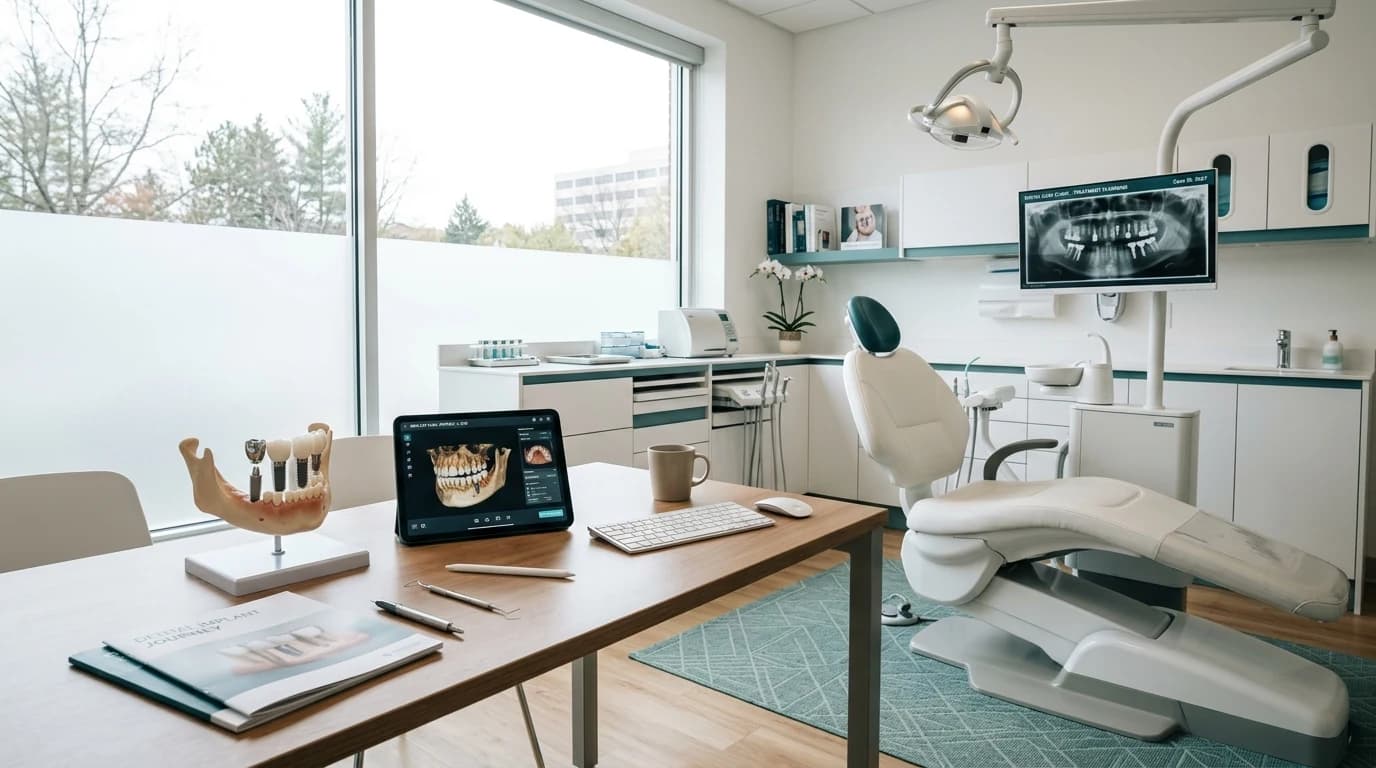
Replacing missing teeth with dental implants is one of the most impactful investments you can make in your oral health—but understanding the cost before you commit matters. If you live on Long Island or in Nassau County, you have likely seen a wide range of prices quoted online, and that inconsistency can make planning feel impossible.
This guide breaks down what dental implants actually cost in 2026, what is included in the price, how insurance and financing factor in, and how implants compare to alternatives like bridges and dentures over time. Use it to walk into your consultation informed and confident—but remember that only an in-person exam can produce a quote specific to your anatomy and goals.
What Is Included in the Cost of a Dental Implant?
When a practice quotes a price for a dental implant, it can mean different things depending on what is bundled. A complete single-tooth implant treatment typically involves three main components: the titanium or zirconia implant post (surgically placed into the jawbone), the abutment (the connector piece), and the custom crown that sits on top and looks like a natural tooth.
Beyond those three pieces, your total investment may also include diagnostic imaging such as 3D cone-beam CT scans, any preparatory procedures like bone grafting or sinus lifts, sedation if you opt for it, and follow-up visits during the healing period. At Meadowbrook Dental Care, we present itemized treatment plans so you can see exactly where every dollar goes—no surprises after the fact.
- Implant post: The surgical component placed into the jawbone, made from biocompatible titanium or zirconia.
- Abutment: A small connector that links the post to the crown; may be stock or custom-milled.
- Crown, bridge, or prosthesis: The visible restoration—porcelain, zirconia, or acrylic depending on the case.
- Preparatory procedures: Bone grafting, ridge augmentation, sinus lifts, or extractions when needed.
- Imaging and planning: 3D scans, digital impressions, and guided surgery planning.
Dental Implant Cost Ranges on Long Island (2026)
The following ranges reflect what patients in the Nassau County and Long Island market can generally expect in 2026. These are all-inclusive estimates covering the implant, abutment, and final restoration for a straightforward case. Complex situations involving grafting, multiple implants, or sedation will fall toward the higher end or above these ranges.
| Treatment | Typical Cost Range | What It Replaces |
|---|---|---|
| Single dental implant | $3,000–$5,500 | One missing tooth |
| Implant-supported bridge | $6,000–$12,000 | 3–4 adjacent missing teeth |
| All-on-4 full arch | $20,000–$30,000 per arch | All teeth in one jaw |
| Implant-retained overdenture | $8,000–$15,000 per arch | Full arch (removable snap-on) |
Disclaimer: These figures are educational estimates for the Long Island area and are not a quote. Your actual cost depends on clinical findings, materials selected, and any additional procedures required. A formal treatment plan and fee schedule require an in-person evaluation.
What Drives the Price Up or Down?
Two patients sitting in the same chair can receive very different quotes for implants, and that is completely normal. Several clinical factors directly influence cost:
- Bone volume and quality: If you have experienced bone loss after an extraction or from periodontal disease, a bone graft may be needed before the implant can be placed. Grafting procedures can add $500–$3,000 depending on the type and extent.
- Number of implants: Replacing a single tooth costs less than replacing several, though multi-implant cases sometimes benefit from economies of scale in the surgical planning.
- Material choices: Zirconia crowns and custom abutments cost more than standard options but offer superior aesthetics and durability, particularly for front teeth.
- Sedation: IV sedation or general anesthesia adds to the total but can make multi-hour procedures far more comfortable.
- Lab and technology: Practices with in-house milling and 3D-guided surgery may charge differently than those outsourcing lab work, but often deliver faster turnaround and higher precision.
Insurance Coverage for Dental Implants
Insurance coverage for implants has historically been limited, but the landscape is gradually shifting. Here is what to expect when you check your insurance benefits:
- Dental PPO plans: Many dental PPO plans now cover a portion of implant treatment—often 50% of the surgical placement up to the plan's annual maximum (typically $1,500–$2,500). The crown may be covered separately under major restorative benefits.
- Dental HMO/DHMO plans: These rarely cover implants or may offer them at a steep copay. Check your schedule of benefits carefully.
- Medical insurance: Medical plans almost never cover dental implants unless the tooth loss resulted from trauma, cancer treatment, or a congenital condition. Even then, pre-authorization is required and coverage is not guaranteed.
- Discount plans: Some dental savings plans offer reduced fees (15–30% off) for implant procedures at participating providers. Meadowbrook Dental's in-house Dental Savings Plan includes 10% off all major services, including implants.
Our front-office team at both the Mineola and Plainview locations can run a complimentary benefits check before your consultation so you know what to expect.
Financing Options and Payment Plans
Even with partial insurance coverage, implants represent a significant out-of-pocket expense for most families. That is why Meadowbrook Dental Care offers flexible financing designed to make treatment accessible:
- 0% interest plans: Qualified patients can spread payments over 12–24 months with no interest charges through third-party financing partners.
- Extended payment plans: Longer terms (up to 60 months) are available at low interest rates for larger cases like All-on-4 or full-mouth reconstruction.
- HSA and FSA accounts: Dental implants are an eligible expense for both Health Savings Accounts and Flexible Spending Accounts—using pre-tax dollars effectively reduces your cost by your marginal tax rate.
- Phased treatment: In some cases, treatment can be staged over multiple calendar years to maximize annual insurance benefits and spread personal expenses.
Implants vs. Bridges vs. Dentures: Long-Term Value
The upfront cost of implants is higher than alternatives, but the total cost of ownership over 20–30 years often tells a different story. Bridges and dentures require periodic replacement, relining, and repair—costs that accumulate significantly over time.
| Criteria | Dental Implant | Fixed Bridge | Removable Denture |
|---|---|---|---|
| Upfront cost (single tooth) | $3,000–$5,500 | $2,500–$5,000 | $500–$2,500 |
| Average lifespan | 25+ years (post); 10–15 years (crown) | 7–15 years | 5–8 years |
| Replacement cost over 30 years | 1–2 crown replacements | 2–4 bridge remakes | 4–6 relines/remakes |
| Bone preservation | Yes—stimulates jawbone | No | No—accelerates bone loss |
| Adjacent teeth affected | None | Requires grinding 2 healthy teeth | Clasps may stress neighboring teeth |
| Estimated 30-year total cost | $4,500–$8,500 | $7,500–$20,000 | $3,000–$15,000 |
When you factor in the health benefits—preserved bone, protected adjacent teeth, and stable function—implants often represent the best long-term value for patients who are good candidates. Learn more about the clinical advantages in our guide to the benefits of dental implants.
Frequently Asked Questions
How much does a single dental implant cost on Long Island?
A single dental implant in the Nassau County area typically costs between $3,000 and $5,500 when the implant post, abutment, and crown are all included. Cases requiring bone grafting, sinus lifts, or premium materials may exceed this range. The only way to get an exact number is through a clinical evaluation with imaging.
Does dental insurance cover implants?
Many dental PPO plans now provide partial coverage for implants, often covering 50% of the surgical placement up to your annual maximum. Coverage varies widely between plans, so we recommend bringing your insurance card to your consultation—our team will verify benefits at no charge. Medical insurance rarely covers implants unless tooth loss resulted from trauma or a medical condition.
Are there 0% interest payment plans for dental implants?
Yes. Meadowbrook Dental Care partners with third-party financing providers that offer 0% interest plans for qualified patients, typically over 12–24 months. Extended-term plans with low interest rates are also available for larger cases. Visit our financing page for details.
Why do implant prices vary so much between practices?
Price differences usually come down to what is included in the quote, the materials used, the level of technology (3D scanning, guided surgery), and the experience of the surgical team. A lower quote that excludes the crown, abutment, or grafting can end up costing more once all components are added. Always ask for an itemized breakdown so you can compare apples to apples.
Is it cheaper to get a bridge instead of an implant?
A bridge typically costs less upfront ($2,500–$5,000 for a three-unit bridge), but it requires grinding two healthy adjacent teeth and has an average lifespan of 7–15 years. Over a 20- to 30-year period, the cumulative cost of bridge replacements often approaches or exceeds the one-time investment in an implant that can last 25+ years with proper care.
Ready for a transparent quote tailored to your situation? Call Meadowbrook Dental Care at (516) 284-1234 (Mineola) or (516) 346-5757 (Plainview), or schedule online to book your free implant consultation.
Get Your Personalized Implant Treatment Plan
Every case is unique. At Meadowbrook Dental Care in Mineola and Plainview, we provide transparent pricing after a thorough exam—so you know exactly what to expect before treatment begins.