
You are eating dinner and notice a quick zing in one of your molars when you sip ice water. It disappears in seconds and you forget about it—until the next night, when it happens again. Is it a cavity? Maybe. Or maybe it is nothing. The frustrating truth is that cavities in their earliest stages often produce zero symptoms, and by the time you feel consistent pain the decay may already be deep enough to need more than a simple filling.
Understanding what a cavity actually feels like at each stage of progression can help you act early, save money, and keep your natural tooth intact. This guide walks through the seven most common signs—from the silent ones your dentist catches on an X-ray to the unmistakable alarms that mean the decay has advanced. If any of these sound familiar, schedule an exam sooner rather than later. Patients across Nassau County and Long Island trust Meadowbrook Dental Care for thorough, comfortable checkups at our Mineola and Plainview offices.
The Silent Stage: When a Cavity Feels Like Nothing
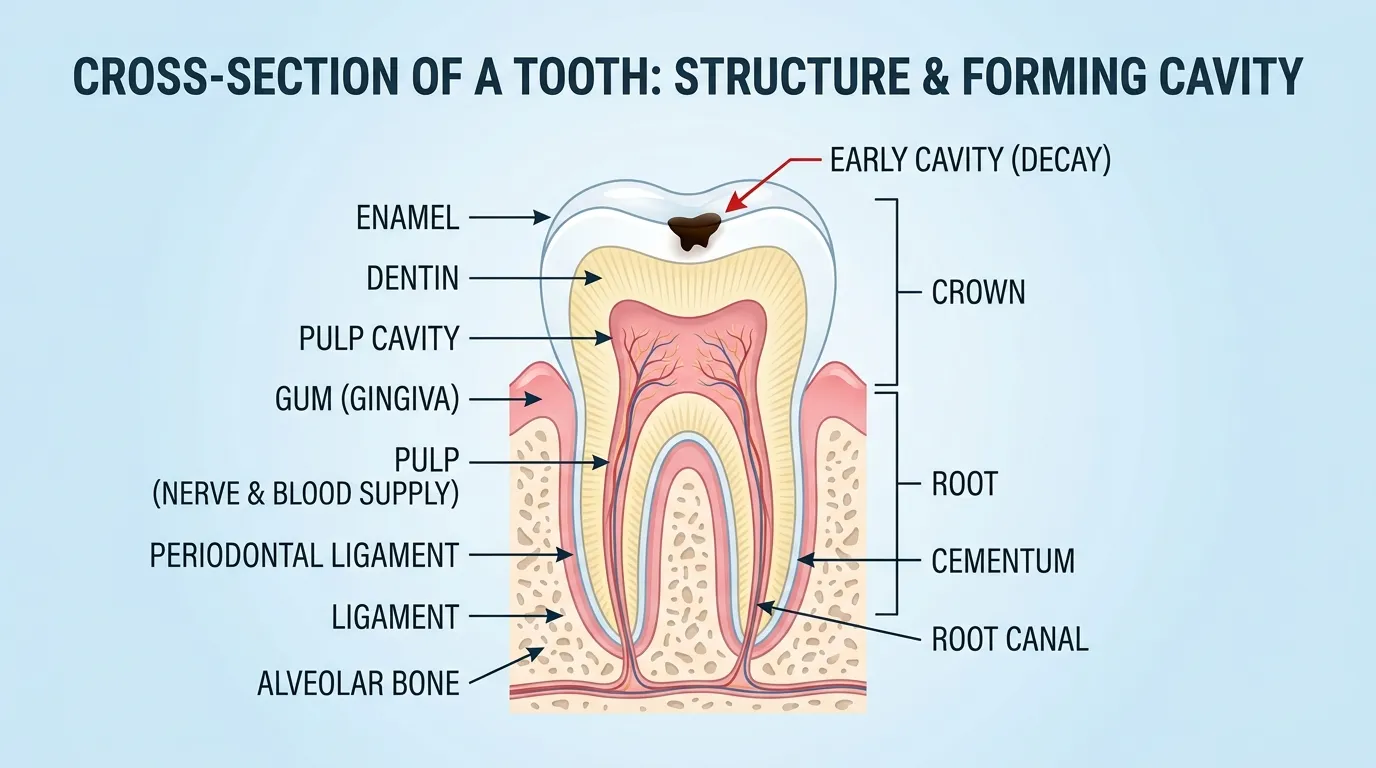
Tooth enamel is the hardest substance in the human body—and it contains no nerves. That means the very first phase of tooth decay, when bacteria produce acid that begins to demineralize the outer enamel surface, is completely painless. You will not feel it, you will not see it, and you will have no reason to suspect anything is wrong.
This is exactly why dentists emphasize twice-yearly exams. At Meadowbrook Dental Care, every routine checkup includes digital X-rays and a careful visual screening. Digital X-rays can reveal demineralization and early interproximal (between-teeth) decay that is invisible to the naked eye. Catching a cavity at this stage may mean nothing more than a fluoride treatment or a very small filling—quick, affordable, and virtually painless.
Three Early Whispers of Decay
Once the decay penetrates through the enamel and reaches the softer dentin layer underneath, your tooth starts sending signals. These early signs are easy to dismiss because they are mild and inconsistent—but recognizing them can save you from a much bigger problem later.
1. Sensitivity to Sweets
You bite into a piece of chocolate or sip a sweetened coffee and feel a brief, sharp twinge in a specific tooth. Sugar (and other simple carbohydrates) can trigger a response in dentin that has been exposed by early decay. The sensation fades quickly once the sugar is gone, so many people write it off as nothing. If it keeps happening in the same spot, it is worth mentioning at your next appointment.
2. Sensitivity to Hot or Cold
A flash of discomfort when you eat ice cream or drink hot soup is one of the classic early cavity symptoms. Healthy enamel insulates the nerve-rich dentin from temperature extremes. When decay thins or breaches that enamel, hot and cold stimuli reach the dentin tubules and produce a quick, zingy sensation. Unlike sensitivity from aggressive brushing or receding gums (which tends to affect multiple teeth), cavity-related sensitivity usually isolates to one tooth.
3. A Mild, Occasional Twinge
Sometimes there is no obvious trigger. You are just going about your day and feel a dull ache or brief twinge in a tooth. It comes and goes unpredictably, and it never lasts long enough to seem urgent. This kind of vague, intermittent discomfort is easy to ignore—but it is your tooth telling you something has changed beneath the surface.
Four Louder Alarms That Decay Has Advanced
If the early whispers go unaddressed, the decay continues to spread. Once it reaches deeper into the dentin—or worse, approaches or enters the pulp (the nerve and blood supply at the center of the tooth)—the symptoms become harder to ignore.
4. Visible Stains, Pits, or Holes
A dark brown or black spot on a tooth, a rough pit you can feel with your tongue, or a visible hole in the enamel are all signs that decay has physically broken down the tooth structure. Not every stain is a cavity—coffee and tea can discolor teeth superficially—but any new dark spot that appears in a groove or between teeth warrants a professional evaluation.
5. Pain When Biting Down
When a cavity weakens enough of the tooth structure, biting or chewing on that tooth produces a sharp, localized pain. This happens because the compromised enamel and dentin flex under pressure, stimulating the nerve beneath. If you find yourself avoiding one side of your mouth when you eat, that is a strong signal.
6. Sharp, Spontaneous Toothache
A throbbing or sharp pain that arrives without any food or temperature trigger usually means the decay has reached—or is very close to—the pulp. At this point, inflammation of the nerve (pulpitis) is likely underway. The pain may wake you up at night, come in waves, or radiate into your jaw and ear. This is the stage at which a simple filling is often no longer sufficient and a root canal and crown may be necessary.
7. Food Constantly Getting Trapped
If food packs into the same spot every time you eat and flossing does not easily clear it, the tooth may have a cavity that has created a physical trap. Over time, trapped food accelerates bacterial growth and speeds up the decay. This sign is easy to overlook because it feels like an inconvenience rather than a dental problem—but persistent food impaction in one area should be evaluated.
Cavity Progression: What Happens at Each Stage
The table below shows how a cavity evolves, what you are likely to feel at each phase, and what treatment is typically needed. The further right you move on this timeline, the more complex and expensive treatment becomes—which is why early detection through regular dental checkups is so valuable.
| Stage | What You Feel | What's Happening | Treatment Needed |
|---|---|---|---|
| Enamel demineralization | Nothing—completely painless | Acid softens the outer enamel; white or chalky spots may appear | Fluoride treatment or remineralization |
| Enamel cavity | Occasional sensitivity to sweets or cold | Decay breaks through enamel into outer dentin | Small composite filling |
| Deep dentin cavity | Frequent sensitivity; pain when biting; visible hole | Decay spreads through dentin toward the pulp | Larger filling or inlay/onlay |
| Pulp involvement | Spontaneous throbbing pain; pain that wakes you at night | Bacteria infect the nerve and blood supply | Root canal + crown |
| Abscess / tooth loss | Severe, constant pain; swelling; fever possible | Infection spreads beyond the tooth into bone and soft tissue | Extraction (possibly emergency); implant or bridge to replace |
Disclaimer: The treatment listed for each stage is a general guideline. Your dentist will recommend the best approach based on the specific location, size, and extent of the decay.
Why Regular Checkups Catch Cavities Before Pain
By the time a cavity hurts, it has already progressed well beyond the enamel. The entire point of biannual dental exams is to find decay during the silent or early-whisper stages, when treatment is fast, minimally invasive, and far less expensive. At Meadowbrook Dental Care on Long Island, every exam includes:
- Digital X-rays that expose up to 90% less radiation than traditional film and reveal decay between teeth and below the gum line.
- Visual and tactile screening by the dentist, who checks every surface of every tooth for soft spots, staining, and structural changes.
- Gum health assessment to identify early signs of periodontal disease, which often coexists with decay.
Combined, these tools let your dentist diagnose a cavity months or even years before it produces symptoms—saving you time, discomfort, and money.
What to Do If You Suspect a Cavity
If any of the signs above sound familiar, the single best thing you can do is schedule a dental exam. Do not wait for the pain to become unbearable—by that point, a routine filling may no longer be an option and you could be facing a root canal, a crown, or even an extraction.
In the meantime, avoid chewing on the affected side, stick to lukewarm foods and drinks to minimize sensitivity, and keep up your brushing and flossing routine. Over-the-counter pain relievers like ibuprofen can take the edge off, but they are managing symptoms, not treating the cause. If you experience severe, throbbing pain or visible swelling, contact an emergency dentist immediately—an abscess is a medical concern that should not wait.
Frequently Asked Questions
Can a cavity go away on its own?
Once a cavity has physically broken through the enamel, it cannot reverse itself. Very early enamel demineralization (a pre-cavity) can sometimes be remineralized with fluoride treatments, prescription toothpaste, and improved oral hygiene—but this only works before a hole has formed. Once there is a hole, the tooth must be repaired by a dentist.
How long can you leave a cavity untreated?
There is no safe timeline. Some cavities progress slowly over months; others advance quickly, especially if your diet is high in sugar or your saliva production is low. The risk of leaving any cavity untreated is that it will reach the pulp, cause an infection, and potentially require extraction. The safest approach is to treat it as soon as it is discovered.
Does a cavity always hurt?
No. In fact, the most treatable cavities—those confined to the enamel—are completely painless. Pain typically begins when the decay reaches the dentin and intensifies as it approaches the pulp. Waiting for pain before seeing a dentist means the decay has already progressed significantly.
What does a cavity look like?
Early cavities may appear as white chalky spots on the enamel. As they progress, they darken to light brown, dark brown, or black. You might also see a visible pit, hole, or rough area on the tooth surface. However, many cavities form between teeth where they are invisible without an X-ray, which is why professional exams are essential.
Is it too late to save a tooth with a large cavity?
Not necessarily. Even teeth with large cavities can often be saved with a root canal and a protective crown. However, if the decay has destroyed too much tooth structure or the infection has spread into the surrounding bone, extraction may be the only option. The sooner you seek treatment, the more options you have.
Think you might have a cavity? Call (516) 284-1234 (Mineola) or (516) 346-5757 (Plainview) to schedule your exam, or book your appointment online.
Catch Cavities Before They Cause Pain
Meadowbrook Dental Care uses digital X-rays and thorough visual exams to detect decay at its earliest stage—when treatment is simplest and most affordable. Schedule your checkup at our Mineola or Plainview office.