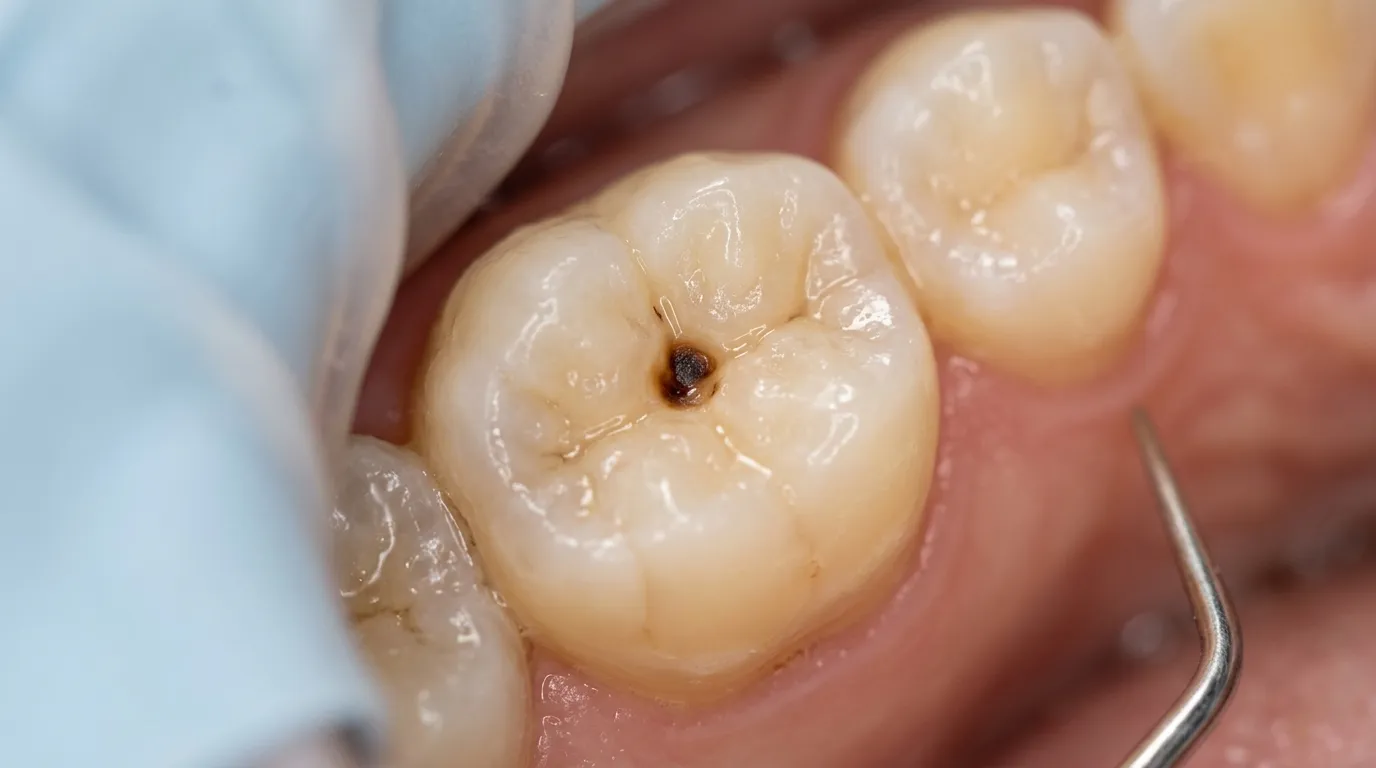
Most cavities start so small you cannot see or feel them. A tiny patch of weakened enamel, invisible to the naked eye, barely registers on your radar — and that is exactly what makes tooth decay so dangerous. Without treatment, a cavity does not stay small. It progresses through predictable stages, each one more painful, more complex to treat, and more expensive to fix than the last.
At Meadowbrook Dental Care, we see patients on Long Island every week who delayed treatment on a cavity they knew about — sometimes for months, sometimes for years — only to discover that what would have been a simple filling now requires a root canal, a crown, or even an extraction. This article walks you through exactly what happens inside your tooth at each stage of untreated decay so you can make an informed decision about when to act. For a side-by-side explanation of those treatments, see our guide to fillings, crowns, and root canal treatment.
Stage 1: Enamel Demineralization — The Silent Start
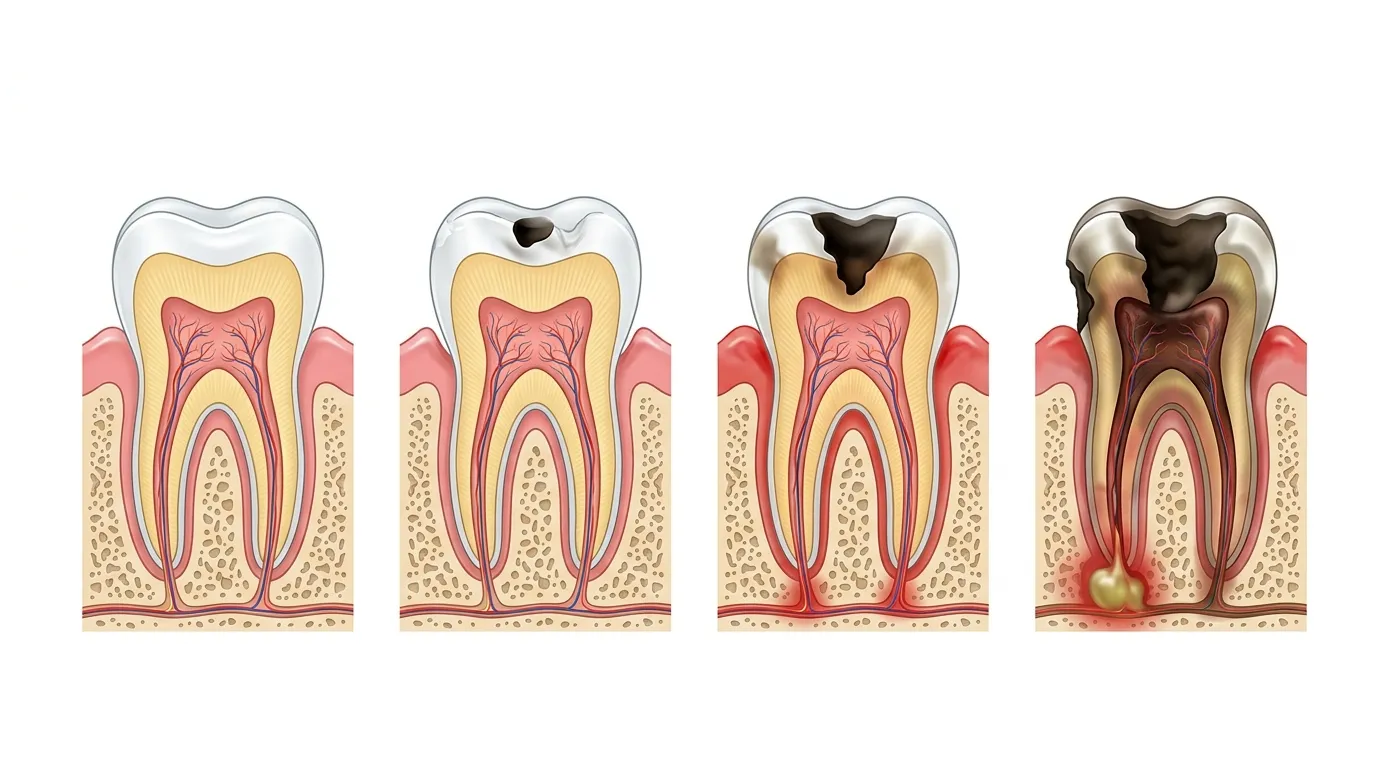
Tooth decay begins when acids produced by oral bacteria dissolve minerals from the enamel surface. At this stage, you will not feel anything. There is no hole in the tooth yet — only a subtle change in the enamel's structure. Clinically, this shows up as a white spot or chalky patch on the tooth surface, most commonly near the gum line or in the grooves of back teeth.
The good news is that demineralization is reversible. Fluoride treatments, prescription-strength toothpaste, and improved oral hygiene can remineralize the enamel and stop decay in its tracks before a cavity ever forms. This is one of the key reasons routine dental checkups matter — your dentist can spot white-spot lesions during a visual exam or with diagnostic tools long before you feel any symptoms. At this stage, the cost of intervention is essentially zero beyond your regular cleaning visit.
Stage 2: Enamel Cavity — The First Real Hole
If demineralization continues unchecked, the enamel surface breaks down and a small physical hole — a cavity — forms. Enamel is the hardest substance in the human body, but it has no living cells and cannot repair itself once a hole has formed. You may notice mild sensitivity to sweets or cold drinks, or you might feel nothing at all. Many enamel cavities are found only on dental X-rays during a routine exam.
Treatment at this stage is straightforward: a simple composite filling that typically costs $150–$300 and takes about 30 minutes. The dentist removes the small area of decay and fills the space with tooth-colored resin. There is minimal discomfort, often no anesthesia needed for very small cavities, and the tooth is fully restored in a single appointment. This is the easiest, fastest, and cheapest point at which to treat a cavity — and the point at which most patients wish they had acted.
Stage 3: Dentin Decay — The Cavity Picks Up Speed
Beneath the enamel lies dentin, a softer, yellowish layer that makes up the bulk of the tooth's structure. Dentin contains microscopic tubes (tubules) that lead directly toward the nerve. Once decay reaches dentin, two things change: the cavity grows faster because dentin is much softer than enamel, and you start to feel it. Sensitivity to hot, cold, and sweet stimuli becomes noticeable. You may experience a dull ache when chewing or a sharp twinge when eating something sugary.
Treatment now requires a larger filling or, if enough tooth structure has been lost, an inlay or onlay. The cost rises to $250–$500 depending on the size and location of the restoration. The procedure still takes one appointment in most cases, but the filling is bigger, more anesthesia is needed, and there is a higher chance the tooth will remain sensitive for a few weeks after treatment. The window for a simple fix is closing.
Stage 4: Pulp Infection — Now You're in Serious Pain
The pulp is the innermost chamber of the tooth, containing the nerve, blood vessels, and connective tissue. When bacteria from the cavity penetrate through the dentin and reach the pulp, infection sets in. This is the stage where patients typically can no longer ignore the problem. Symptoms include severe, throbbing pain that may wake you up at night, prolonged sensitivity to hot and cold that lingers for 30 seconds or more, and pain that radiates into the jaw and ear.
A filling is no longer sufficient. The infected pulp tissue must be removed through a root canal procedure, and the tooth needs a dental crown to restore its strength afterward. The combined cost of a root canal plus crown on Long Island ranges from $1,500 to $3,000, depending on the tooth's location. A front tooth with a single canal is on the lower end; a molar with three or four canals is on the higher end. What started as a $200 filling is now a $2,000+ procedure — and the tooth, while saved, is permanently weaker than it would have been with earlier treatment.
Stage 5: Dental Abscess — A Dangerous Infection
If the infected pulp is not treated, bacteria continue to multiply and push past the root tip into the surrounding bone. A pocket of pus called an abscess forms at the base of the root. Symptoms are hard to miss: intense, constant pain, significant facial swelling on the affected side, a foul taste from pus draining into the mouth, fever, and sometimes difficulty opening the jaw or swallowing.
A dental abscess is a medical emergency. The infection can spread to the jaw, neck, and — in rare but life-threatening cases — the brain. At this stage, treatment begins with emergency dental care to manage the infection: antibiotics, drainage of the abscess, and pain control. A root canal may still save the tooth if enough structure remains, but extraction is sometimes the only option. Treatment costs escalate to $2,000–$4,000+ when you factor in emergency visits, antibiotics, the root canal or extraction, and the eventual restoration.
Stage 6: Tooth Loss — The Most Expensive Outcome
When decay, infection, and bone loss have destroyed too much of the tooth, extraction is the only option. Losing a tooth creates a chain reaction: adjacent teeth begin to shift into the gap, the opposing tooth may over-erupt, your bite alignment changes, and the jawbone in the extraction site starts to resorb. Over time, a single missing tooth can compromise the health and stability of the teeth around it.
Replacing a missing tooth with a dental implant costs $3,000–$5,500 on Long Island, including the implant post, abutment, and crown. A dental bridge is a less expensive alternative at $2,000–$4,000, but it requires filing down the two adjacent teeth to support the restoration. Either way, you are now investing thousands of dollars and months of treatment time to replace a tooth that could have been saved with a $200 filling years earlier.
The Real Cost of Waiting: Stage-by-Stage Breakdown
The following table illustrates how treatment complexity and cost escalate with each stage of untreated decay. The numbers speak for themselves.
| Stage | What You Feel | What's Happening | Treatment Needed | Approximate Cost |
|---|---|---|---|---|
| 1. Demineralization | Nothing | Minerals leaching from enamel surface | Fluoride treatment, improved hygiene | $0–$50 |
| 2. Enamel cavity | Mild or no sensitivity | Small hole in enamel | Simple filling | $150–$300 |
| 3. Dentin decay | Sensitivity to hot, cold, sweets | Cavity reaches softer inner layer | Larger filling or inlay | $250–$500 |
| 4. Pulp infection | Severe throbbing pain | Bacteria infect the nerve | Root canal + crown | $1,500–$3,000 |
| 5. Abscess | Intense pain, swelling, fever | Pus pocket forms at root tip | Emergency care, root canal or extraction | $2,000–$4,000+ |
| 6. Tooth loss | Tooth broken or extracted | Structure destroyed beyond repair | Extraction + implant or bridge | $3,000–$5,500+ |
Disclaimer: These cost ranges are educational estimates for the Nassau County / Long Island area. Your actual cost depends on the tooth's location, extent of decay, and your insurance plan. A personalized quote requires an in-office evaluation.
Why Early Detection Changes Everything
The pattern is clear: every stage you skip costs more money, more time in the dental chair, and more of your natural tooth structure. A $200 filling today prevents a $5,000 problem tomorrow. That is not a marketing slogan — it is the literal math of how tooth decay progresses.
Regular dental exams every six months allow your dentist to catch cavities at Stage 1 or 2, when treatment is fast, painless, and affordable. Digital X-rays can detect decay between teeth that is invisible to the eye. At Meadowbrook Dental Care, our Mineola and Plainview offices use advanced diagnostic imaging to identify problems at the earliest possible point — often before you have any symptoms at all. Rated 4.9 stars with over 1,000 Google reviews, our team focuses on conservative, preventive care that saves you money and preserves your natural teeth.
How to Prevent Cavities From Forming
Prevention is always more effective and less expensive than treatment. The fundamentals of cavity prevention are well established and straightforward:
- Brush twice daily with a fluoride toothpaste for at least two minutes each session, making sure to reach every surface of every tooth.
- Floss once daily to remove plaque and food particles from between teeth where your toothbrush cannot reach — this is where many cavities start.
- Limit sugary and acidic foods, especially between meals. Frequent snacking bathes your teeth in acid throughout the day, accelerating enamel breakdown.
- Drink water throughout the day, particularly fluoridated tap water, to rinse away food particles and support remineralization.
- Keep your dental appointments — professional cleanings remove hardened plaque (tarite) that brushing alone cannot eliminate, and exams catch problems before they progress.
For patients who are cavity-prone, your dentist may recommend additional measures such as prescription-strength fluoride rinse, dental sealants on the chewing surfaces of back teeth, or more frequent cleaning intervals. These targeted strategies can reduce cavity risk significantly for high-risk patients.
Frequently Asked Questions
How long can a cavity go untreated before it becomes serious?
There is no fixed timeline because the speed of decay depends on factors like oral hygiene, diet, saliva flow, and the specific bacteria present in your mouth. Some cavities progress from enamel to pulp in six months; others take two or more years. The only safe assumption is that decay never reverses on its own once a hole has formed — it only gets worse. If you know you have a cavity, the best time to treat it is now.
Can a cavity heal itself without a dentist?
Only at the very first stage — demineralization — before a physical hole exists. At this point, fluoride, saliva minerals, and improved oral hygiene can remineralize and strengthen the weakened enamel. Once the surface is broken and a cavity has formed, the damage is permanent and can only be repaired with a dental restoration. No amount of brushing, oil pulling, or home remedies will close a hole in a tooth.
I have a cavity but it doesn't hurt — do I still need to treat it?
Yes. Pain means the decay has already reached the deeper layers of the tooth where nerves are present. A painless cavity is actually good news — it means the decay is still in the enamel or early dentin stage where a simple, inexpensive filling can solve the problem. Waiting until it hurts means waiting until the treatment is more invasive and more expensive. Think of a painless cavity as your window of opportunity, not a reason to delay.
What should I do if I think I have a cavity but haven't been to the dentist in years?
Start with a comprehensive exam. At Meadowbrook Dental Care, we see patients in exactly this situation regularly, and our team is focused on solutions — not judgment. We will assess the current state of your oral health, prioritize any issues that need immediate attention, and create a realistic treatment plan that works with your budget and schedule. The hardest part is making the first call.
Does dental insurance cover cavity fillings?
Most dental insurance plans cover fillings under "basic services" at 70–80% after your deductible, making out-of-pocket costs very manageable. More advanced procedures like root canals and crowns fall under "major services" at 50–80% coverage. The less advanced the treatment you need, the more your insurance covers — another strong argument for catching cavities early. If you are unsure about your benefits, our team will verify your coverage before any treatment begins.
Do not let a small cavity become a big problem. Call Meadowbrook Dental Care at (516) 284-1234 (Mineola) or (516) 346-5757 (Plainview), or schedule online to book a checkup and get ahead of decay before it costs you time, money, and teeth.
Catch It Early — Before It Gets Expensive
A routine exam at our Mineola or Plainview office can detect cavities in the earliest, most treatable stage. Don't let a small problem become a big one.