Quick Answer
A tooth does not need to look intact to be saveable. Even when a large filling has fallen out or much of the chewing surface has broken away, the root and a rim of healthy tooth may provide a workable foundation. Conversely, a tooth that looks only mildly damaged can have a deep vertical fracture that makes a crown unreliable. Appearance alone does not answer the question.
Dentists decide by examining the remaining structure, pulp, root, gum, and supporting bone as one system. For patients in Mineola, Plainview, and across Nassau County, the practical goal is not simply to place a crown; it is to choose treatment likely to remain comfortable and functional. This article offers general education, not a diagnosis. Only an in-person exam and appropriate dental imaging can determine whether your specific tooth is restorable.
What a Crown Needs in Order to Work
A dental crown covers the visible part of a prepared tooth and distributes chewing forces around it. It cannot reinforce a tooth unless it has a stable foundation. The dentist generally looks for healthy root structure, manageable decay, adequate bone and gum support, and enough solid tooth for the crown to resist loosening.
One important feature is the ferrule: a collar of sound tooth encircled by the crown near the gumline. This helps the restored tooth resist flexing and fracture. There is no single visible percentage that proves a tooth can be crowned. Tooth position, bite force, fracture direction, root shape, and the quality of remaining structure all affect the decision.
Damage That Can Often Be Rebuilt
Large cavities, failed fillings, and fractured cusps are common reasons teeth need crowns. After all decay and unsupported material are removed, a dentist may replace the missing center with a bonded core buildup. The buildup is not a substitute for a healthy root; it creates the shape needed to support the final crown.
- Large filling with thin walls: a crown may protect the remaining cusps from splitting under chewing pressure.
- Broken cusp above the gum: the tooth is often restorable when the fracture does not continue deeply into the root.
- Deep decay: a crown may work after complete decay removal if a clean, sealable margin can be established.
- Root-canal-treated tooth: a buildup and crown often restore a weakened back tooth after the diseased pulp is removed.
When Additional Treatment May Make a Crown Possible
If decay or a break has reached the pulp, the tooth may need endodontic treatment before restoration. Warning signs can include spontaneous pain, lingering heat or cold sensitivity, swelling, or tenderness when biting. Our guide to signs you may need a root canal explains these patterns, but symptoms alone are not conclusive.
When damage extends slightly below the gum, crown lengthening can reshape gum and sometimes a small amount of bone to expose sound tooth. In selected cases, orthodontic extrusion slowly moves more of the root above the gum. A post placed inside a properly treated root canal may retain a buildup when little tooth remains, but a post does not strengthen the root and can introduce its own risks. The supporting root must still be suitable.
How Dentists Judge Whether a Tooth Is Restorable
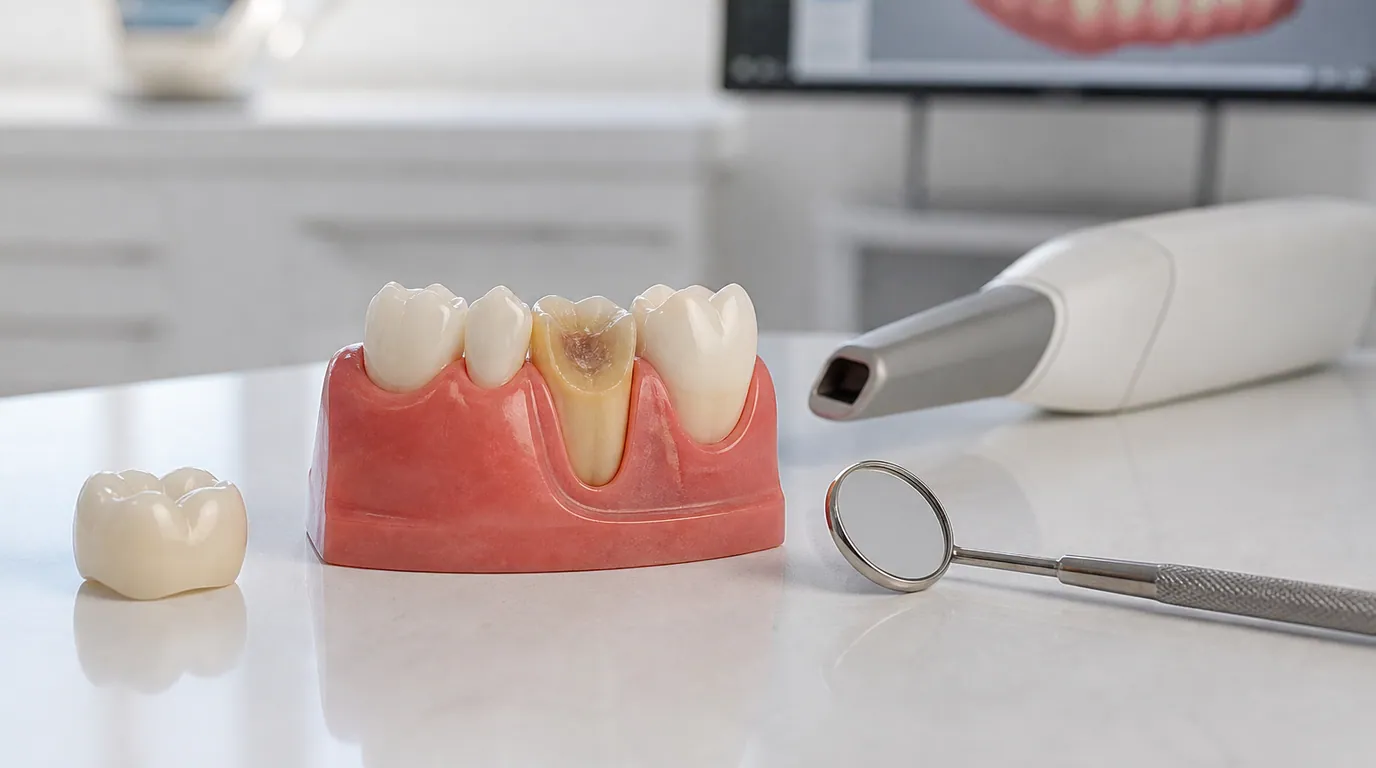
A clinical exam checks for mobility, gum-pocket depth, missing walls, decay, and pain under pressure. Dental X-rays help show bone support, root shape, decay between teeth, and infection near the root tip. Cracks do not always appear on routine X-rays, so the dentist may also use magnification, transillumination, bite tests, temperature testing, or remove an old filling to inspect the tooth directly.
| Finding | Crown May Still Be Reasonable | Why Extraction May Be Considered |
|---|---|---|
| Remaining tooth | Sound structure can be exposed and securely encircled | Decay extends too far below the bone to create a clean seal |
| Crack pattern | Fractured cusp or contained crack above the root | Split tooth or vertical root fracture |
| Pulp and infection | Healthy pulp or infection treatable with root canal therapy | Persistent infection with a root that cannot be predictably treated |
| Gum and bone support | Stable support and maintainable gum health | Severe mobility or advanced localized support loss |
| Overall plan | Tooth adds useful function and fits a maintainable bite | Prognosis is poor despite extensive, repeated procedures |
Signs a Crown May Not Be the Safest Choice
A crown cannot fuse a tooth that has split into independently moving segments. It also cannot stop disease left beneath its edge. A vertical root fracture, extensive root decay, non-restorable perforation, or insufficient bone support can make extraction the more predictable recommendation. If a tooth cannot be saved, a dental implant is one replacement option, but bridges and removable appliances may also be appropriate depending on the site and the patient.
Prognosis is not always simply “good” or “hopeless.” A borderline tooth may be technically treatable yet carry a meaningful risk of future fracture or recurrent decay. Ask what procedures are required before the crown, what could cause failure, and what the backup plan would be. A clear comparison helps you weigh preserving the tooth against cost, time, and predictability without assuming that the most complex option is automatically best.
Red Flags That Need Prompt or Emergency Care
Arrange prompt dental care for worsening pain, pain on biting, a lost restoration, a visible crack, pus, a bad taste, or localized gum swelling. Seek same-day emergency dental evaluation for severe pain, rapidly increasing facial swelling, fever with dental swelling, or trauma that leaves a tooth loose or displaced. Difficulty breathing or swallowing, swelling spreading toward the eye or neck, or uncontrolled bleeding warrants emergency medical care.
Until you are examined, avoid chewing on the tooth and keep the area gently clean. Do not place aspirin, caustic liquids, or household glue on it. Over-the-counter pain medicine may help when taken exactly as labeled and when it is safe with your health conditions and other medicines, but it does not repair the cause.
Questions to Ask Before Committing to a Crown
- How much sound tooth and root support remain?
- Is there evidence of a crack, infection, or nerve damage?
- Will I need a buildup, root canal, or gum procedure first?
- What is the expected prognosis, and what uncertainties remain?
- What are the alternatives if the tooth cannot be restored?
At Meadowbrook Dental Care, the decision starts with diagnosis rather than a predetermined procedure. Long Island patients deserve to understand both the tooth-saving path and its limits before treatment begins.
Frequently Asked Questions
Can a crown save a tooth that is mostly filling?
Sometimes. A crown can cover a tooth with a very large filling, but the dentist must first confirm that enough sound tooth and root support remain. A bonded core buildup may replace missing structure beneath the crown. If decay or a fracture extends too far below the gum or into the root, another treatment may be safer.
Can a badly decayed tooth get a crown without a root canal?
Yes, if the decay can be removed without exposing or irreversibly inflaming the pulp. A root canal is considered when the nerve is infected, dead, exposed, or unlikely to recover. Symptoms and X-rays help guide that decision, but the final finding may become clear only after the decay is removed.
What if there is almost no tooth above the gumline?
A crown may still be possible if the root is healthy and the dentist can create a stable band of sound tooth for the crown to grip. Core buildup, crown lengthening, or orthodontic extrusion may expose usable structure. These procedures are not appropriate for every root or fracture pattern.
Is extraction better than crowning a questionable tooth?
Not automatically. Preserving a predictable natural tooth is usually valuable, but repeated treatment on a tooth with a poor prognosis may not be wise. The choice should compare restorability, gum and bone support, expected longevity, cost, treatment time, and the options for replacing the tooth if it is removed.
If a damaged tooth is painful, broken, or losing a filling, call Meadowbrook Dental Care at (516) 284-1234 (Mineola) or (516) 346-5757 (Plainview). We can examine the tooth and explain whether a crown or a different treatment offers the safest, most predictable next step, or you can review our dental crown treatment options before your visit.
Find Out Whether Your Tooth Can Be Saved
A focused exam at Meadowbrook Dental Care can clarify whether a crown, root canal, or another approach offers the most predictable result for your tooth.