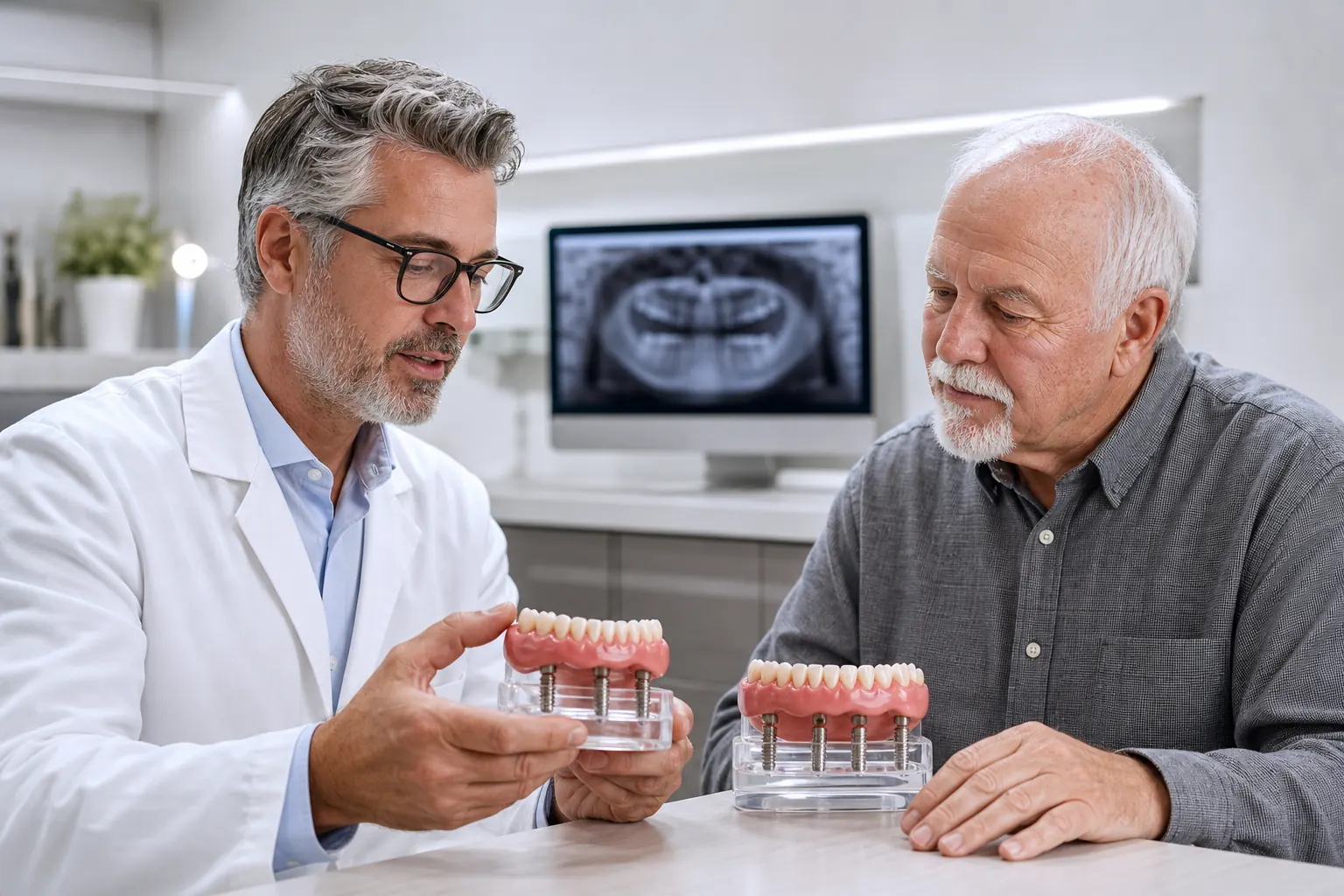
Quick Answer
When every tooth in an arch is failing or missing, implant number can sound like a product tier: six must be better than four because it is more. Full-arch dentistry is not that simple. The implants, jawbone, bridge, bite, and cleaning design function as one system. Adding implants can be valuable, but only when they can be placed in useful positions and supported by healthy anatomy.
This article compares the clinical planning behind All-on-4 and All-on-6. It is intentionally different from a dedicated All-on-4 price guide: cost is one factor, but the central question is why a team might recommend four implants for one Long Island patient and six for another. An examination and cone-beam CT scan are required for an individual recommendation.
What the Names Describe—and What They Leave Out
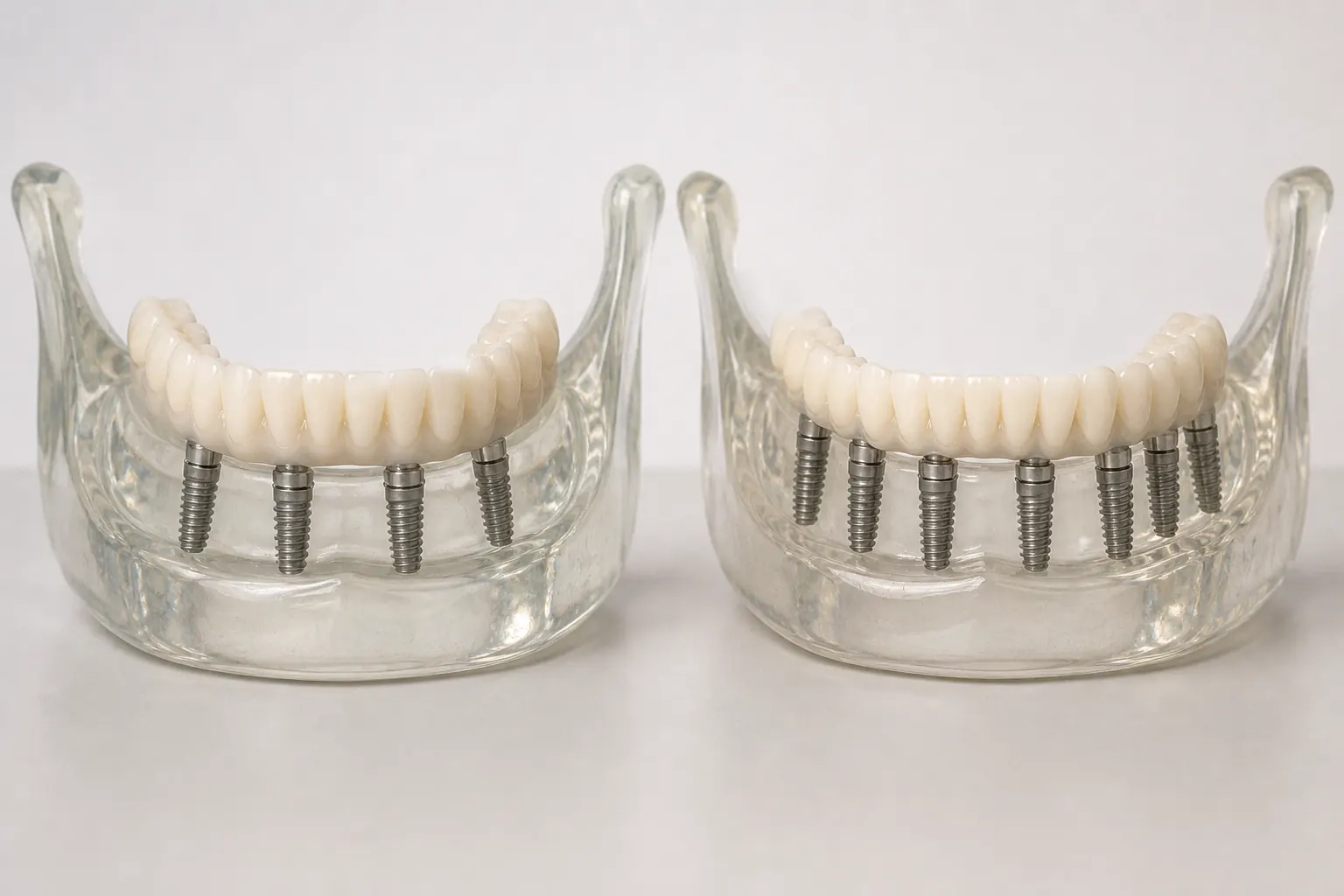
Both approaches replace a complete upper or lower arch with a bridge supported by dental implants. In a common All-on-4 arrangement, two implants are placed toward the front and two posterior implants may be angled to use available bone and reduce the cantilever behind the last support. An All-on-6 plan places six implants across the arch, generally seeking broader distribution when anatomy permits.
The labels omit implant dimensions, exact positions, bone quality, bridge material, loading protocol, and whether extractions, grafting, sedation, temporary teeth, or maintenance are included. Two plans with the same name can differ substantially.
All-on-4 is a specific treatment concept, while “All-on-6” is often used more generally to describe a six-implant full-arch restoration. Patients should ask to see the proposed implant positions on their own scan and learn how the bridge will be supported. Our full-arch implant service provides context for the overall treatment pathway.
All-on-4 vs. All-on-6: Practical Comparison
Four implants can be an efficient design for patients with limited posterior bone or for those seeking to reduce surgical scope. Six may allow shorter spans between supports and give the restorative team more options if an implant later becomes unusable, although continued function would depend on the remaining positions and a redesigned prosthesis. Neither option can promise freedom from future complications.
| Planning Factor | All-on-4 | All-on-6 |
|---|---|---|
| Implants per arch | Four | Six |
| Bone strategy | May use angled posterior implants to avoid limited areas | Needs useful bone and spacing for two additional sites |
| Surgical scope | Fewer implant sites | More implant sites and planning constraints |
| Support distribution | Effective when four positions are well distributed | May reduce distance between supports |
| Cleaning access | Must clean beneath bridge and around four sites | Must clean beneath bridge and around six sites |
| Best fit | Anatomy favors a strategic four-implant design | Bone and restorative plan benefit from added supports |
Long Island Costs and How to Compare Quotes
On Long Island, All-on-4 treatment commonly ranges from about $20,000 to $30,000 per arch. A six-implant full-arch plan may range from roughly $24,000 to $36,000 or more per arch. The difference is not simply the price of two implant posts. Additional surgery, components, restorative complexity, and laboratory design can affect the total. Zirconia or other premium final materials may also cost more than acrylic-based options.
Compare written scopes line by line. Confirm whether the quote includes extractions, 3D imaging, surgical guides, sedation, grafting, immediate temporary teeth, final teeth, implant components, follow-up visits, and the final prosthesis material. Ask what happens financially if an implant cannot be immediately loaded or if the plan changes after teeth are removed. A low advertised figure may describe only one phase.
Disclaimer: These figures are educational estimates for the Long Island market and are not a quote. Your actual cost depends on implant number and position, anatomy, materials, extractions, sedation, grafting, and the temporary and final prosthesis design. A formal fee requires an examination and 3D imaging.
Insurance may contribute to limited components but often leaves a substantial patient responsibility. The full dental implant overview can help frame questions about surgical and restorative phases before comparing financing terms.
How Bone, Bite, and Prosthesis Design Drive the Choice
Cone-beam CT imaging maps bone volume and density as well as nerves, sinuses, and other anatomy. Six implants are useful only if the additional sites improve distribution without compromising safe positioning. Patients with posterior bone loss may be better served by angled implants in a four-implant concept, while others have anatomy that supports six in favorable locations. Bone grafting for implant treatment may expand options, but it adds healing, expense, and procedure-specific risks and is not automatically necessary.
The restorative plan should guide surgery. The team first considers where teeth need to emerge for speech, appearance, lip support, and a balanced bite, then plans implants to support that endpoint. Implant positions clustered too closely may add little value. Excessive cantilever—the unsupported bridge extending beyond the last implant—can increase force on components, so distribution can matter more than a raw count.
Grinding, a powerful bite, the opposing teeth, and available restorative space influence the material and support strategy. Medical history, tobacco use, gum health, and ability to clean are equally important. Full-arch implants are elective surgical treatment and may not be advisable until active disease or health risks are stabilized.
Recovery, Maintenance, and Making a Measured Decision
With either design, extractions and implant placement may occur during one surgical phase. A fixed temporary bridge can sometimes be attached that day if implant stability and bite conditions meet the clinical criteria. “Teeth in a day” refers to temporary teeth, not completed healing. Patients usually follow a modified diet while bone integrates, and the final prosthesis is made after the tissues stabilize.
Six implant sites do not necessarily mean dramatically more discomfort, but surgical experiences vary with extraction difficulty, grafting, health, and individual response. Instructions on medication, hygiene, diet, and follow-up take priority over general timelines online. New or increasing swelling, fever, uncontrolled bleeding, or worsening pain should be reported promptly.
Long-term maintenance is similar for both options: clean above and below the bridge every day, attend professional implant maintenance, and use a night guard if prescribed. More implants create more tissue interfaces to monitor, not fewer obligations. Prosthetic teeth and screws can wear, loosen, chip, or require replacement even when the implants remain healthy.
A sound recommendation should explain why each proposed implant improves the design. Ask to review alternatives, what additional implants achieve, and what compromises follow if anatomy supports only four. Patients at our Mineola and Plainview offices should leave planning with a clear rationale—not the impression that one number is universally superior.
Frequently Asked Questions
Is All-on-6 automatically stronger than All-on-4?
Not automatically. Two additional implants may increase support or provide more restorative options when bone and spacing permit, but strength also depends on implant position, bone quality, prosthesis design, bite forces, material, and maintenance. Four well-planned implants can be more appropriate than six placed in compromised positions. The entire system must be evaluated, not the implant count alone.
Can All-on-4 be changed to All-on-6 later?
Sometimes additional implants can be placed later, but conversion is not a simple guaranteed upgrade. Available bone, the positions and angles of existing implants, the design of the bridge, and changes in anatomy all matter. If six implants may be desirable, it is better to discuss that possibility during initial 3D planning rather than assume two can always be added.
Do both options provide temporary teeth on the day of surgery?
Immediate temporary teeth may be possible with either approach when the implants achieve adequate initial stability and the bite can be controlled. It is not appropriate in every case. If immediate loading is unsafe, a removable temporary or a delayed fixed prosthesis may be recommended. The final bridge is usually made after healing and tissue changes are assessed.
How do I clean an All-on-4 or All-on-6 bridge?
Both require brushing around the bridge and implants plus cleaning underneath with tools such as floss threaders, interdental brushes, or a water flosser as instructed. Professional maintenance is essential because the bridge can hide plaque accumulation. The number of implants does not eliminate the need for daily access beneath the prosthesis or regular evaluation of the surrounding tissues.
To compare full-arch options using your own anatomy, call Meadowbrook Dental Care in Mineola at (516) 284-1234 or Meadowbrook Dentistry in Plainview at (516) 346-5757, or request a full-arch consultation. The team can explain implant distribution, bridge design, risks, and an itemized estimate after examination and 3D imaging.
Choose a Full-Arch Plan Based on Your Anatomy
Compare four- and six-implant full-arch designs with 3D imaging, restorative planning, and a clear explanation of tradeoffs at our Mineola or Plainview office.