Quick Answer
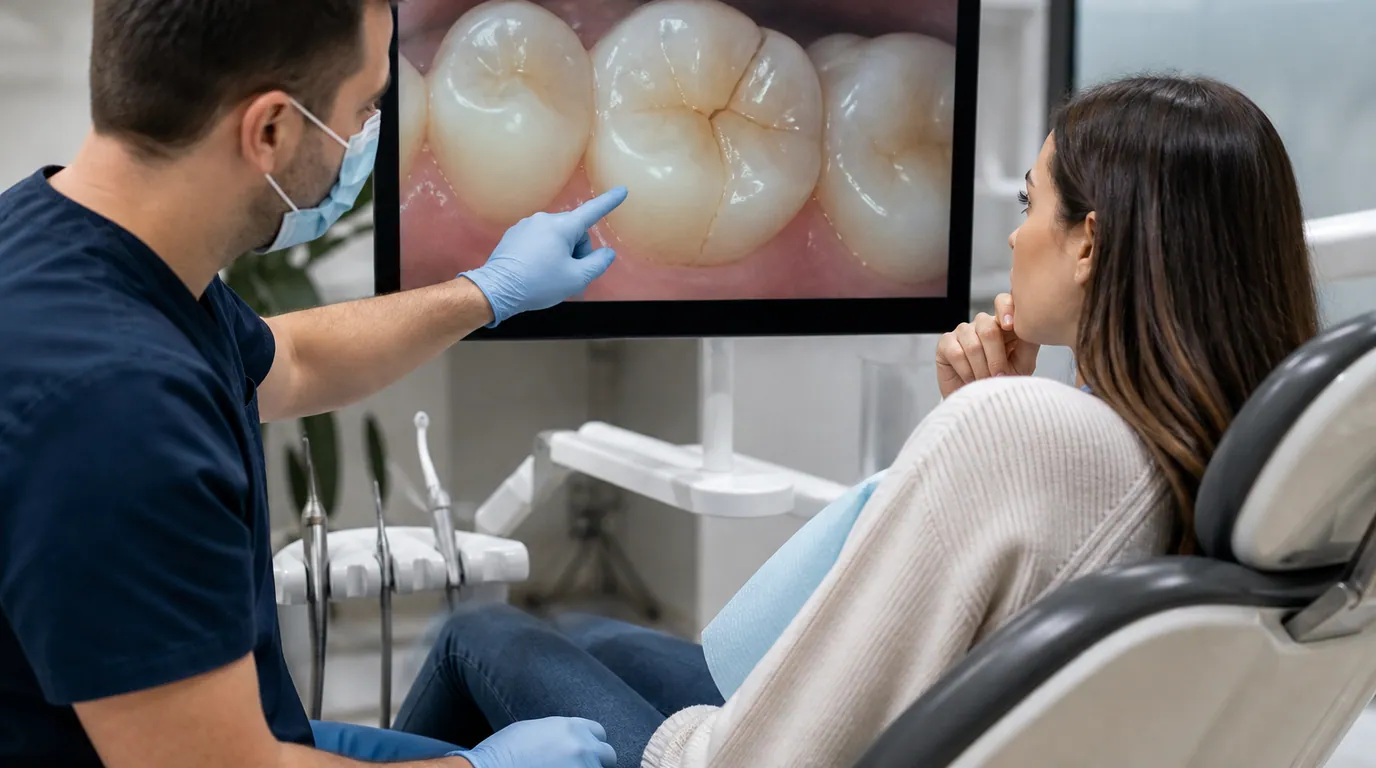
A cracked tooth can be frustrating because the pain may come and go. You might feel a sharp jolt on one bite and nothing on the next, or notice cold sensitivity without visible damage. Tiny movements along a fracture can irritate the living pulp, and the crack may be difficult to see even with dental imaging.
The chance of saving the tooth depends mainly on where the fracture begins, how far it extends, whether the pulp is healthy, and whether the root and surrounding bone remain stable. Prompt assessment gives Long Island patients more options. This information is educational and cannot diagnose your tooth; treatment decisions require an in-person dental exam and appropriate imaging.
Symptoms That Can Point to a Cracked Tooth
Cracks produce a wide range of symptoms. Some affect only enamel and never hurt. Others irritate or infect the pulp. Common clues include sharp pain while chewing, pain as you release a bite, sensitivity to cold or sweets, tenderness that is hard to pinpoint, and intermittent discomfort around a heavily filled tooth.
Swelling, a pimple-like bump on the gum, spontaneous throbbing, or lingering heat sensitivity can indicate pulp or tissue involvement. A crack can also exist without symptoms, particularly early on. Similar complaints can come from a loose filling, bite problem, decay, sinus pressure, or gum disease, so symptom matching is not enough for a reliable diagnosis.
Not Every Line in a Tooth Means the Same Thing
Dentists describe fractures by their location and extent because those features guide treatment. A craze line is a shallow enamel line and is usually cosmetic. A fractured cusp commonly develops around a large filling and may be repairable. A cracked tooth has an incomplete fracture extending from the chewing surface toward the root. A split tooth has separated into distinct segments, while a vertical root fracture begins in the root and travels upward.
| Fracture Pattern | Typical Clues | Common Management | General Outlook |
|---|---|---|---|
| Craze line | Visible surface line, usually no pain | Monitoring or cosmetic treatment | Usually favorable |
| Fractured cusp | Piece breaks near a filling; bite sensitivity possible | Onlay or crown, depending on remaining structure | Often favorable when contained |
| Cracked tooth | Sharp, inconsistent chewing pain; cold sensitivity | Crown, sometimes root canal therapy | Depends on depth and pulp health |
| Split tooth | Deep fracture with independently moving segments | Extraction; occasionally a selected segment is retained | Poor for saving the whole tooth |
| Vertical root fracture | Localized deep gum pocket, recurrent infection, few early symptoms | Usually extraction or root removal in selected multi-rooted teeth | Often unfavorable |
This table describes common patterns, not a self-diagnosis tool. The same symptom can occur with more than one condition, and the visible portion of a crack may not reveal where it ends.
How a Dentist Determines Whether the Tooth Is Saveable
Evaluation starts with the history: what triggers pain, how long it lasts, and whether the tooth has a large filling, prior root canal, or recent injury. The dentist may inspect under magnification, shine a bright light through the tooth, test individual cusps with a bite tool, measure gum pockets, and check how the pulp responds to temperature. Dental X-rays can reveal decay, bone loss, or infection, although many cracks are too fine or poorly angled to show directly.
Restorability matters as much as locating the crack. The tooth needs enough sound structure and periodontal support to hold a durable restoration. Removing an old filling may be needed before the extent becomes clear. Referral to an endodontist may be appropriate when pulp or root involvement is uncertain.
Treatment Options for Saving a Cracked Tooth
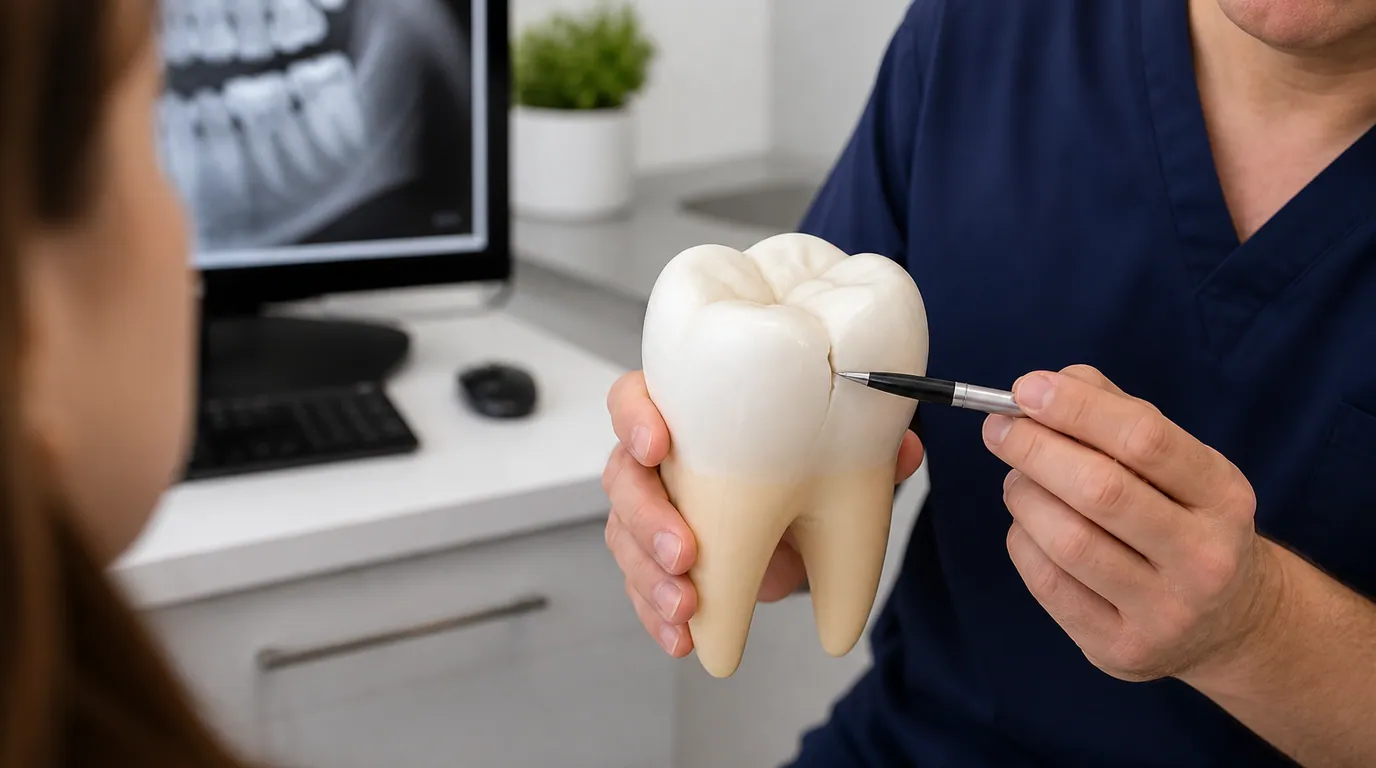
Treatment aims to stop the tooth from flexing and protect the pulp. Minor enamel defects may only need smoothing, monitoring, or cosmetic bonding. A damaged cusp may be restored with an onlay or a dental crown. Full coverage surrounds the tooth and redistributes chewing force, but it does not guarantee that a deep crack will never progress.
When the pulp is irreversibly inflamed or infected but the root is restorable, root canal therapy removes the damaged tissue and seals the canals. The tooth is then protected with a crown in many cases. Review the common warning signs of pulp damage, while remembering that testing—not pain intensity alone—determines whether endodontic treatment is indicated.
Early treatment generally preserves more choices, but no ethical clinician can promise that every crack will stabilize permanently. Prognosis depends on whether the fracture crosses the pulp, extends below the gum, reaches the root, or creates a deep periodontal pocket. Ask what remains uncertain and how the tooth will be monitored.
When Extraction Becomes Necessary
Extraction is usually considered when the tooth has split into separate pieces, the crack travels vertically through the root, decay prevents a sealable restoration, or gum and bone support are severely compromised. It may also be the more predictable choice when saving the tooth would require several procedures yet still carry a poor prognosis.
Removing a tooth is not a failure when retaining it would prolong pain or infection. If extraction is necessary, replacement choices may include a bridge, removable partial denture, or dental implant. Timing, bone condition, neighboring teeth, health, and budget influence the plan; replacement does not always occur on the extraction day.
What to Do While You Wait for an Exam
Stop chewing on the affected side and avoid ice, hard candy, popcorn kernels, and extreme temperatures. Rinse gently with warm water and keep the area clean. Save any broken piece in a clean container. Do not test the crack repeatedly, use household glue, or place aspirin on the gum.
Over-the-counter pain medicine can reduce symptoms when taken according to the label and when compatible with your health conditions, allergies, pregnancy status, and other medications. It does not stop a fracture or eliminate infection. Contact an emergency dentist promptly for pain on biting, worsening sensitivity, a new break, or swelling rather than waiting for the tooth to settle on its own.
Red Flags: When a Cracked Tooth Is an Emergency
Seek same-day dental care for severe or escalating pain, facial or gum swelling, fever associated with dental symptoms, pus or a foul taste, a loose tooth after trauma, uncontrolled oral bleeding, or a fracture exposing red or pink tissue. Call emergency medical services or go to an emergency department for difficulty breathing or swallowing, swelling spreading toward the eye or neck, significant facial trauma, loss of consciousness, or bleeding that will not stop.
A hospital can address airway risk, major trauma, and spreading complications, but tooth repair generally requires a dentist. Meadowbrook Dental Care can assess urgent symptoms at our Long Island offices after an examination.
Can Future Cracks Be Prevented?
Not every crack is preventable, especially when a tooth has been weakened by a very large restoration or unexpected trauma. Risk can be reduced by avoiding chewing ice and other hard objects, wearing an athletic mouthguard, and addressing clenching or grinding. Routine exams can identify loose fillings, decay, and weakened cusps before a major piece breaks. Our guide to handling a chipped or broken tooth also explains first-aid steps after an injury.
Frequently Asked Questions
Can a cracked tooth heal by itself?
No. Enamel and dentin do not knit back together like bone. Treatment can stabilize the tooth, protect the crack, and address pulp damage, but it cannot make the fracture disappear. Delaying care may allow movement, bacteria, and chewing pressure to extend the crack.
Can a cracked tooth be saved with a crown?
Many cracked teeth can be stabilized with a crown when the crack is contained and the root is not split. The crown surrounds the tooth and limits flexing during chewing. If the crack has inflamed or infected the pulp, root canal therapy may also be necessary before the final crown.
How does a dentist find a crack that is not on an X-ray?
Cracks are often diagnosed by combining the symptom history with magnification, transillumination, bite testing, pulp tests, periodontal probing, and removal of an old filling when appropriate. X-rays help identify infection and bone changes, but a fine crack may not align with the X-ray beam and may remain invisible.
How long can I wait to treat a cracked tooth?
There is no reliably safe waiting period because crack depth and progression differ. A painless craze line can usually be assessed routinely, while pain on biting, lingering temperature sensitivity, swelling, or a mobile segment needs prompt care. Severe pain, spreading swelling, fever, or trauma calls for same-day evaluation.
If you suspect a crack, call Meadowbrook Dental Care at (516) 284-1234 (Mineola) or (516) 346-5757 (Plainview). Prompt examination can distinguish a manageable fracture from a split tooth and help preserve the safest available options. You can also review our same-day emergency dental care.
Concerned About a Cracked Tooth?
Prompt evaluation can reveal how far the crack extends and whether bonding, a crown, root canal treatment, or extraction is the most predictable option.