Quick Answer
Hearing that a tooth needs treatment often leads to a practical question: why this procedure and not a simpler one? A filling, crown, and root canal solve different problems. The right choice is not based on pain alone or on how dark a spot looks in the mirror. It depends on where the damage is, whether the nerve is healthy, and whether the tooth can withstand normal chewing after it is repaired.
For patients in Mineola, Plainview, and across Nassau County, the goal of a diagnostic visit is to preserve healthy tooth structure while choosing a restoration strong enough for the situation. This guide explains the reasoning dentists use. It is educational, not a diagnosis for a particular tooth; an in-person exam is necessary before treatment.
The Three Treatments Solve Different Problems
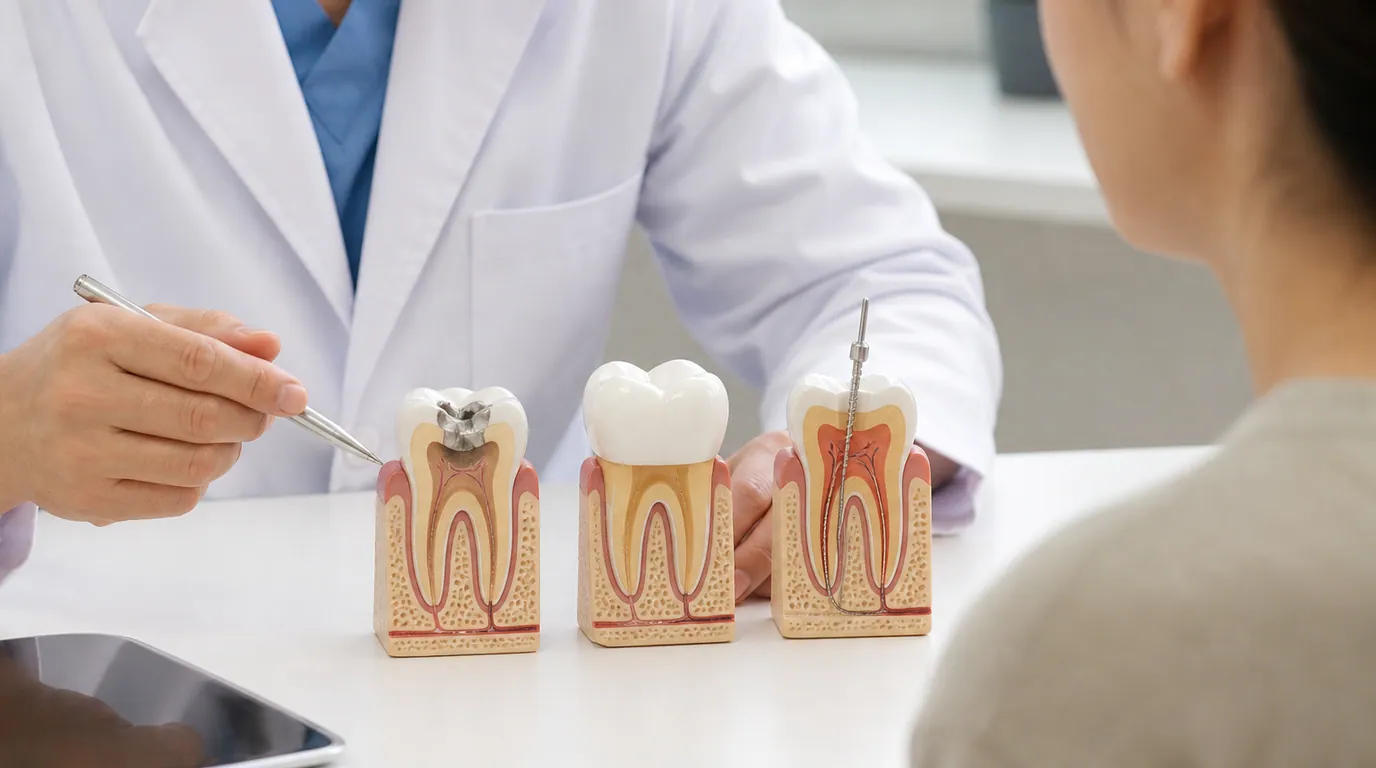
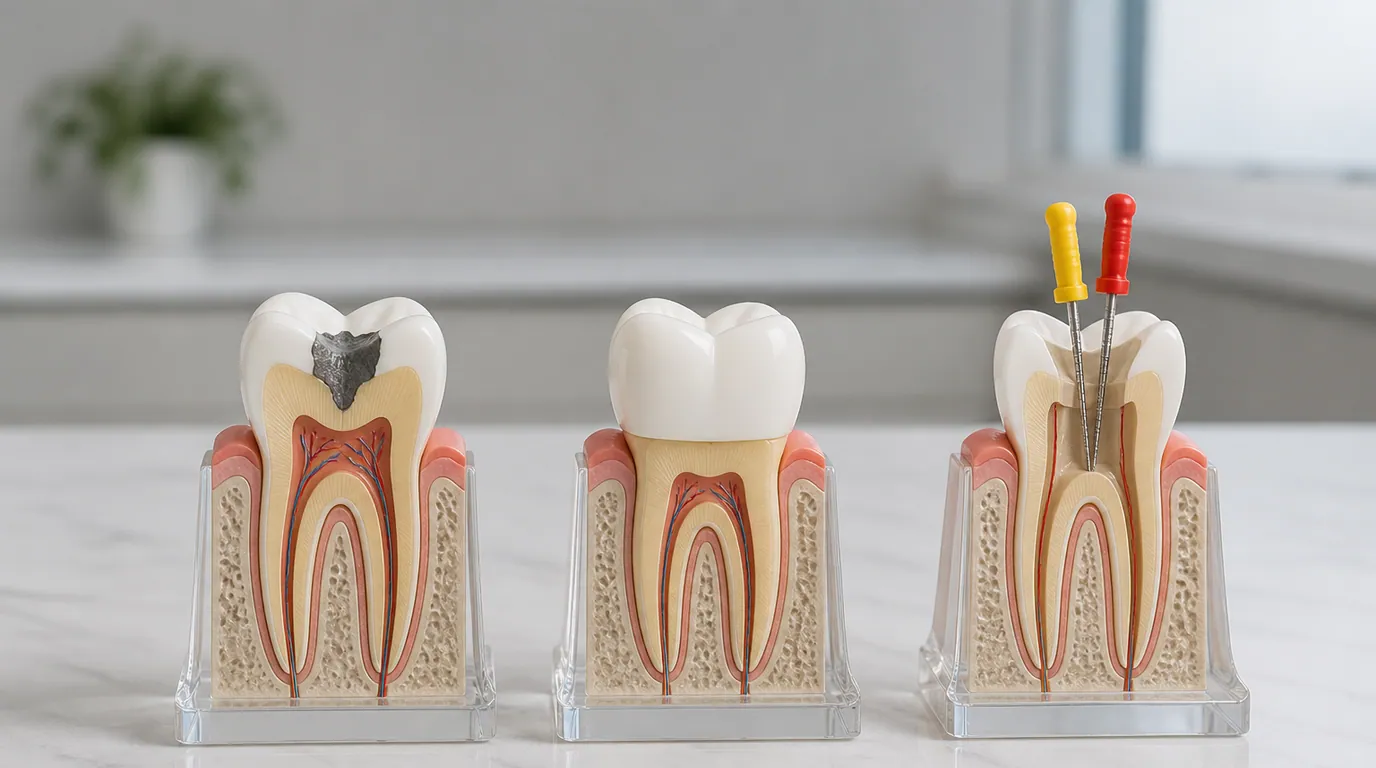
A filling replaces a relatively small area lost to decay or minor damage. After removing compromised material, the dentist bonds restorative material into the prepared area. This works best when the remaining walls and biting surface are strong enough to support the repair.
A dental crown covers most or all of the visible tooth above the gumline. It redistributes chewing force around a weakened tooth rather than concentrating pressure on thin sections. A crown may be recommended after a large cavity, a fracture, repeated fillings, or root canal treatment.
A root canal addresses the inside of the tooth. The dentist removes irreversibly inflamed or infected pulp, cleans and seals the canal space, and then restores the opening. Because a root canal does not rebuild a missing cusp or cracked outer shell, back teeth commonly need a crown afterward. Review the common signs that a tooth may need root canal treatment, but remember that testing is needed to confirm the cause.
How Fillings, Crowns, and Root Canals Compare
| Question | Filling | Crown | Root Canal |
|---|---|---|---|
| Main problem treated | Limited decay or a small defect | Weak, cracked, or extensively restored tooth | Inflamed, infected, or dead pulp |
| Area treated | Part of the outer tooth | Most of the visible tooth | Nerve space inside roots and crown |
| Typical diagnostic clues | Localized damage with strong walls remaining | Large defect, fracture, or weakened cusps | Lingering temperature pain, spontaneous pain, or infection |
| May be combined with another? | Sometimes supports another restoration | Often follows a root canal on a back tooth | Often followed by a filling or crown |
| What it cannot do | Reliably brace a severely weakened tooth | Treat infection inside the pulp | Restore missing outer strength by itself |
What Dentists Check Before Recommending Treatment
The decision begins with your history. Pain that lasts after hot or cold, wakes you from sleep, or starts without a trigger raises different concerns than a brief twinge while eating something sweet. The dentist also asks about trauma, grinding, recent dental work, and whether biting or releasing pressure causes pain.
During the exam, the dentist looks for decay, failing filling edges, fractures, discoloration, swelling, and how much sound enamel and dentin remain. Bite paper can reveal a heavy contact that overloads one tooth. Cold, heat, tapping, or electric pulp tests help compare the tooth's nerve response with neighboring teeth. Periodontal probing may reveal a narrow, deep pocket associated with a crack.
Dental X-rays help estimate decay depth, show previous restorations, and reveal changes around a root tip. They do not show every crack, so the clinical findings matter. A dentist combines the evidence rather than using one result in isolation. Routine general dentistry exams can identify smaller problems before treatment becomes more extensive.
When a Filling Is Usually Enough
A filling is often appropriate when decay is confined to a manageable area, the pulp appears healthy, and the remaining tooth can tolerate chewing. It is also useful for small chips or replacing a modest failed restoration. Bonded fillings preserve more natural structure than a crown because less tooth usually needs preparation.
However, placing an oversized filling is not always the conservative choice. If a cavity undermines a cusp or an old filling occupies much of the chewing surface, the remaining shell may flex and crack. In that setting, coverage with a crown can protect more tooth over time. Learn how decay can progress in our guide to what a cavity may feel like. Early cavities may have no symptoms, which is one reason pain alone should not determine treatment.
When a Crown Provides Better Protection
A crown becomes more likely when the tooth has lost substantial structure, one or more cusps are fractured, or a large restoration leaves thin walls. Dentists also consider the tooth's job. A molar absorbs greater chewing loads than a front tooth, and grinding or clenching can increase those forces. The recommendation should balance strength, appearance, gum health, and the amount of tooth that can be preserved.
Not every crack can be saved with a crown. A limited crack above the gum may be stabilized, while a split tooth or fracture extending far down the root can have a poor outlook. The dentist may temporarily protect the tooth or gather additional diagnostic information before making a definitive plan. If a crown is recommended, ask what finding makes full coverage safer than another filling.
When the Pulp Changes the Plan
Decay, trauma, or a crack can reach the pulp. Reversible irritation may settle once the cause is removed, but irreversible inflammation or infection generally requires root canal treatment if the tooth is restorable. Warning signs can include lingering hot or cold pain, spontaneous throbbing, tenderness to biting, a gum bump, swelling, or darkening. Some infected teeth cause little pain, so imaging and testing remain important.
If there is facial swelling, fever, trouble swallowing, or rapidly increasing pain, seek prompt emergency dental care. Antibiotics may be appropriate for certain spreading infections, but they do not remove infected tissue from inside a tooth. Definitive treatment could involve a root canal, drainage, or extraction depending on the examination.
How to Discuss the Recommendation
A clear treatment conversation should cover what the dentist found, what each option is expected to accomplish, and what could happen if you wait. Ask whether the nerve appears healthy, how much strong tooth remains, and whether a crack is suspected. It is also reasonable to discuss alternatives, sequence, follow-up, and the limits of what can be known before treatment begins.
Occasionally, the extent of decay becomes fully visible only after an old filling is removed. A planned filling may need to become a crown, or deep decay may expose an already compromised pulp. Your dentist should explain this possibility in advance when it is foreseeable. The aim is not to choose the biggest procedure; it is to select the least extensive treatment that predictably addresses both disease and structural risk.
Frequently Asked Questions
Can a dentist tell whether I need a filling or crown from an X-ray?
An X-ray can show decay depth, old restorations, bone changes, and some infections, but it is only part of the decision. Your dentist also examines the tooth, tests the bite and nerve response, and considers how much healthy structure remains. Small cracks may not appear clearly on an X-ray.
Does needing a crown mean I also need a root canal?
No. A crown restores and protects weakened tooth structure, while a root canal treats inflamed, infected, or dead pulp inside the tooth. Many crowned teeth have healthy pulp and never need root canal treatment. When both are needed, the root canal is generally completed before the final crown.
Can a large cavity still be treated with a filling?
Sometimes, but size is not the only factor. A large filling may leave thin walls that can fracture under chewing pressure. A crown or another type of indirect restoration may provide safer coverage. The tooth location, crack pattern, bite force, and amount of sound enamel all influence the recommendation.
What symptoms mean I should not wait for an appointment?
Prompt care is appropriate for severe or escalating pain, facial swelling, fever, drainage, trauma, or difficulty swallowing. These signs can accompany infection or significant damage. A broken tooth without severe pain also deserves timely evaluation because exposed areas can worsen even when they do not hurt.
If you have tooth pain, a broken filling, or a treatment recommendation you want to understand, call Meadowbrook Dental Care in Mineola at (516) 284-1234 or Meadowbrook Dentistry in Plainview at (516) 346-5757. Our team can examine the tooth and explain which option fits the findings. You can learn about comprehensive dental examinations before scheduling.
Find Out What Your Tooth Actually Needs
A focused exam at Meadowbrook Dental in Mineola or Plainview can identify whether your tooth needs a filling, protective crown, root canal treatment, or another approach.