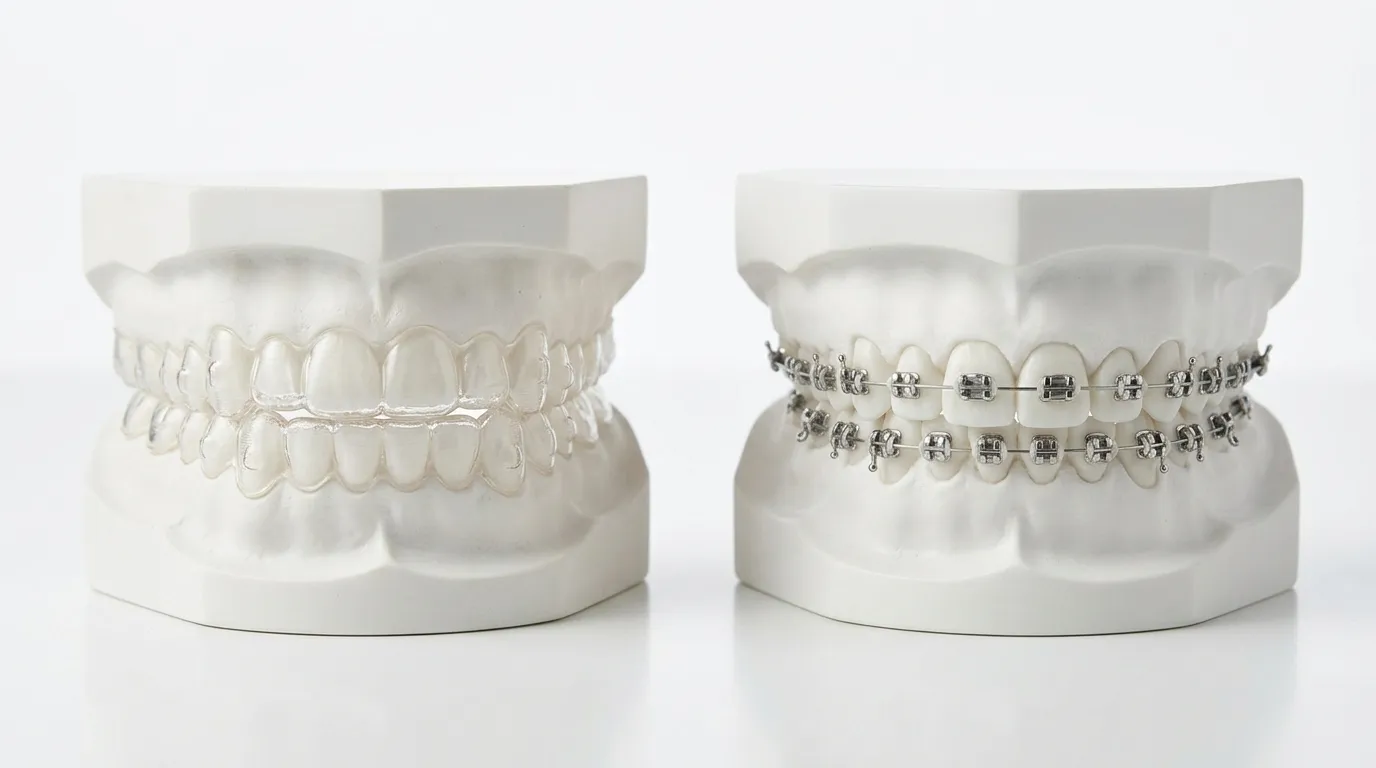
Straightening your teeth as an adult is more common than ever. The American Association of Orthodontists reports that one in three orthodontic patients today is over 18, and the options available have expanded well beyond the metal brackets most of us remember from middle school. For adults on Long Island weighing Invisalign against traditional braces, the decision comes down to lifestyle, budget, treatment complexity, and personal preference.
This guide offers a head-to-head comparison across every factor that matters — aesthetics, comfort, speed, cost, food restrictions, office visits, candidacy, and compliance — so you can walk into your consultation with clear expectations. We also include a detailed comparison table covering Invisalign, traditional metal braces, and ceramic braces side by side.
Aesthetics: Clear Aligners vs. Visible Brackets
For most adults, appearance is the single biggest factor driving the choice. Invisalign aligners are made from nearly invisible medical-grade thermoplastic. Unless someone is standing inches from your face, they will not notice you are wearing them. That discretion matters in professional settings, social events, and everyday interactions where adults simply do not want to look like a teenager in braces.
Traditional metal braces use stainless-steel brackets and archwires that are clearly visible when you smile or speak. Ceramic braces split the difference — tooth-colored brackets blend in better than metal but are still noticeable, especially if the archwire is metallic. If aesthetics rank high on your priority list, clear aligners are the decisive winner.
Comfort and Day-to-Day Experience
Invisalign trays are smooth, custom-fitted shells with no brackets or wires to irritate your cheeks and gums. Each new set of aligners may cause mild pressure for the first day or two as teeth begin to shift, but the discomfort is generally described as a dull ache rather than sharp pain. You can remove the trays to eat, brush, and floss, which means your oral hygiene routine stays virtually unchanged.
Braces, on the other hand, can cause sore spots inside the lips and cheeks — particularly after adjustments. Orthodontic wax helps, but the hardware is always present. Brushing and flossing around brackets takes more time and effort, and many patients find they need specialized tools like interdental brushes and floss threaders. Over the full course of treatment, most adults find Invisalign noticeably more comfortable on a daily basis.
Treatment Time: How Long Does Each Option Take?
Invisalign treatment for adults typically ranges from 6 to 18 months for mild to moderate alignment issues. Complex cases involving significant bite correction may take longer, but the majority of adult Invisalign patients at Meadowbrook Dental Care in Mineola and Plainview complete treatment within 12 to 14 months.
Traditional braces usually require 18 to 36 months, though simple cases can sometimes wrap up in about a year. The broader range reflects the fact that braces are often chosen for more complex orthodontic problems — severe crowding, large overbites, or skeletal discrepancies — that inherently take longer to resolve regardless of the appliance type.
Cost Comparison on Long Island
Cost is the question every adult patient asks first. Invisalign at Meadowbrook Dental Care starts at $3,300 with $0 down, making it competitive with — and in some cases less expensive than — traditional braces. Here is how the numbers generally break down in Nassau County:
- Invisalign: $3,300–$8,000 depending on case complexity, number of aligners needed, and whether refinements are included.
- Traditional metal braces: $3,000–$7,000 depending on treatment duration and orthodontist fees.
- Ceramic braces: $4,000–$8,500, typically 10–30% more than metal due to the cost of tooth-colored brackets.
Many dental insurance plans cover orthodontic treatment up to a lifetime maximum (commonly $1,500–$2,500), and that benefit applies equally to Invisalign and braces. Meadowbrook also offers flexible financing with 0% interest options so you can spread payments over 12–24 months without a financial penalty.
Disclaimer: These cost ranges are educational estimates for the Long Island area. Your actual investment depends on the complexity of your case, treatment duration, and materials. A personalized quote requires an in-office evaluation.
Food Restrictions, Office Visits, and Compliance
One of Invisalign's biggest lifestyle advantages is the complete absence of food restrictions. Because you remove the aligners to eat, there is no list of forbidden foods — enjoy popcorn, apples, crusty bread, and everything else without worry. Braces patients must avoid hard, sticky, and chewy foods that can snap wires or pop brackets, which many adults find frustrating over a multi-year treatment.
Office visits also differ. Invisalign check-ins are typically scheduled every 8 to 12 weeks and tend to be short — your dentist confirms progress and hands you the next batch of trays. Braces require adjustments every 4 to 6 weeks, and those appointments can be longer when wires need replacing or brackets need rebonding.
The trade-off for Invisalign's flexibility is compliance. Aligners must be worn 20–22 hours per day to stay on track. Removing them for meals and oral care is fine, but patients who leave trays out for extended periods — or forget them at home — will see their treatment timeline slip. Braces, by contrast, work 24/7 because they are bonded to your teeth. If self-discipline is a concern, braces eliminate the compliance variable entirely.
Candidacy: Which Cases Suit Each Option?
Invisalign excels at treating mild to moderate orthodontic issues: crowding, spacing, overbite, underbite, crossbite, and open bite in many adult cases. Advances in aligner technology — including SmartForce attachments and precision cuts for elastics — have expanded the range of treatable conditions significantly over the past five years.
Traditional braces remain the stronger choice for complex cases involving severe crowding, large skeletal discrepancies, teeth that need significant vertical movement, or situations requiring precise torque control. If your orthodontic needs are highly complex, braces may deliver a more predictable result. That said, many cases that were once considered "braces only" can now be handled effectively with Invisalign in the right hands.
At Meadowbrook Dental Care, Dr. Daniela Rendon uses Digital Smile Design technology during your evaluation to show a projected preview of your smile before treatment begins — helping you visualize the end result regardless of which option you choose.

Full Comparison Table: Invisalign vs. Braces vs. Ceramic Braces
| Criteria | Invisalign | Metal Braces | Ceramic Braces |
|---|---|---|---|
| Appearance | Nearly invisible | Highly visible metal | Tooth-colored brackets, less visible |
| Comfort | Smooth trays, mild pressure | Brackets can irritate cheeks | Similar to metal, slightly smoother |
| Treatment time | 6–18 months (typical) | 18–36 months | 18–36 months |
| Cost on Long Island | $3,300–$8,000 | $3,000–$7,000 | $4,000–$8,500 |
| Food restrictions | None — remove to eat | Many (no hard, sticky, chewy foods) | Many (same as metal braces) |
| Office visits | Every 8–12 weeks | Every 4–6 weeks | Every 4–6 weeks |
| Removable | Yes — 20–22 hrs/day wear required | No — fixed for full treatment | No — fixed for full treatment |
| Best for | Mild–moderate cases, lifestyle priority | Complex cases, no compliance concerns | Complex cases with aesthetic preference |
| Oral hygiene | Normal brushing and flossing | Requires special tools | Requires special tools |
| Staining risk | Low (trays replaced every 1–2 weeks) | Low (metal does not stain) | Moderate (ceramic can discolor) |
Why Adults Specifically Prefer Clear Aligners
Beyond the clinical factors, adults choose Invisalign for reasons that teenagers rarely consider. Working professionals value the ability to present confidently in meetings, on video calls, and at networking events without visible orthodontic hardware. Parents appreciate that they can remove trays for family photos. Active adults enjoy the freedom to exercise, play sports, and travel without worrying about bracket emergencies far from their orthodontist.
There is also the psychological factor. Many adults delayed orthodontic treatment for years because they did not want braces in their 30s, 40s, or 50s. Invisalign removes that barrier. At our Long Island offices, we regularly treat patients in their 50s and 60s who finally feel comfortable committing to straighter teeth because the process is virtually invisible. Rated 4.9 stars with over 1,000 Google reviews, Meadowbrook Dental Care has helped hundreds of Nassau County adults achieve the smile they have been putting off.
Frequently Asked Questions
Is Invisalign faster than braces for adults?
In many cases, yes. Invisalign typically takes 6–18 months for mild to moderate alignment issues, while traditional braces average 18–36 months. However, treatment time depends on the complexity of your case. Severe crowding or significant bite correction may take longer with either option.
Can Invisalign fix an overbite in adults?
Yes. Invisalign can effectively treat mild to moderate overbites using SmartForce attachments and precision-cut elastics. Severe skeletal overbites may still require braces or a combination approach. Your evaluation will determine which option gives you the best outcome.
Does insurance cover Invisalign the same as braces?
Most dental plans that include orthodontic benefits apply the same lifetime maximum to both Invisalign and braces — typically $1,500–$2,500. Check with your provider or bring your insurance card to your consultation and our team will verify your benefits at no charge.
What happens if I don't wear my aligners enough?
If you consistently wear aligners fewer than 20 hours per day, your teeth may not track properly. This can lead to poor fit with subsequent trays, slower progress, and the need for additional refinement aligners — extending treatment time and potentially adding cost. Compliance is the single most important success factor with Invisalign.
Can I see what my results will look like before starting?
Absolutely. Meadowbrook Dental Care uses Digital Smile Design to create a projected preview of your post-treatment smile during your initial evaluation. You will see a simulation of how your teeth will move at each stage before you commit to anything.
Ready to find out which option fits your smile and your life? Call Meadowbrook Dental Care at (516) 284-1234 (Mineola) or (516) 346-5757 (Plainview), or schedule online to book your free Invisalign evaluation.
Find Out If Invisalign Is Right for You
Get a complimentary Invisalign evaluation at our Mineola or Plainview office — including a Digital Smile Design preview of your projected results.