
Losing a single tooth leaves you with a practical decision, and the two options most patients weigh are a fixed dental bridge or a dental implant. Both restore your ability to chew and smile with confidence, but they work in very different ways and age very differently over the years that follow.
If you are researching this choice on Long Island, you have probably noticed that opinions vary and prices swing widely. This guide walks through how each option works, what each costs in the Nassau County market, how they affect the health of your jaw, and the specific situations where one tends to be the smarter pick. The goal is to help you arrive at your consultation already understanding the trade-offs, because the right answer depends on your bone, your neighboring teeth, and your long term priorities.
How a Dental Bridge Works
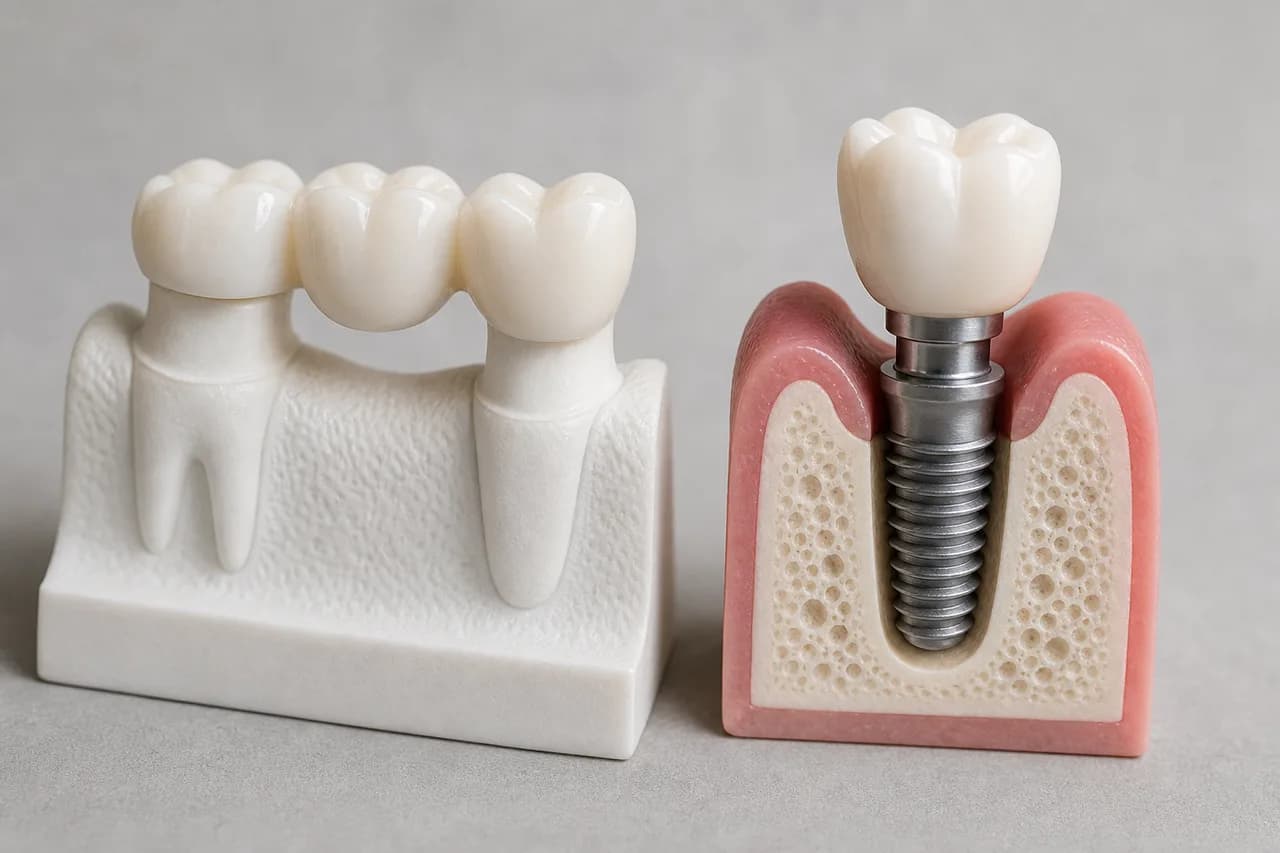
A traditional fixed bridge replaces a missing tooth by anchoring an artificial tooth (called a pontic) to the two natural teeth on either side of the gap. To do this, the dentist reshapes those neighboring teeth and covers them with dental crowns that are fused to the replacement tooth in the middle. The result is a single connected unit that fills the space and stays fixed in place.
Bridges have been a reliable solution for decades. They look natural, restore chewing fairly quickly, and usually cost less upfront than an implant. The main drawback is structural. To support the bridge, two otherwise healthy teeth have to be permanently reduced, and those teeth now carry the load of three. A bridge also does nothing for the bone underneath the missing tooth, which we will return to shortly.
How a Dental Implant Works
A dental implant replaces the entire tooth, root and all. A small biocompatible titanium post is placed into the jawbone, where it fuses with the bone over a few months in a process called osseointegration. Once it has integrated, an abutment and a custom crown are attached on top. The finished implant stands on its own and does not rely on the teeth around it for support.
Because the implant lives in the bone the way a natural root does, it keeps the jaw stimulated and preserves the surrounding teeth in their natural state. The trade-offs are a higher upfront investment and a longer timeline, since the bone needs time to heal around the post before the final crown goes on. For many patients that patience pays off in a restoration that can last for decades.
Bridge vs. Implant: Side by Side
The table below summarizes the practical differences most patients in Mineola and Plainview ask about when they are deciding between the two.
| Factor | Dental Bridge | Dental Implant |
|---|---|---|
| Average lifespan | 7 to 15 years | 25+ years (post); 10 to 15 years (crown) |
| Effect on nearby teeth | Requires reshaping two healthy teeth | Leaves neighboring teeth untouched |
| Protects jawbone | No, bone loss continues under the gap | Yes, stimulates and preserves bone |
| Treatment timeline | 2 to 3 weeks | 3 to 6 months in most cases |
| Upfront cost (single tooth) | $2,500 to $5,000 | $3,000 to $5,500 |
| Cleaning and care | Special floss threaders under the pontic | Brush and floss like a natural tooth |
Cost Comparison on Long Island
Cost is usually the first question, and the honest answer is that a bridge tends to win on day one while an implant tends to win over the long run. A standard three unit bridge in the Nassau County area generally runs $2,500 to $5,000, while a complete single implant with the post, abutment, and crown typically falls between $3,000 and $5,500.
The fuller picture appears when you look at replacement cycles. A bridge usually needs to be remade once or twice over a 20 to 30 year span, and each remake can again involve the supporting teeth. An implant post often lasts the rest of your life, with only the crown needing occasional attention. Our guide to the cost of dental implants breaks the numbers down further, and our team can verify your financing options before you commit to anything.
Disclaimer: These figures are educational estimates for the Long Island area and are not a quote. Your actual cost depends on clinical findings, materials, and whether any preparatory procedures are needed. A formal treatment plan requires an in-person evaluation.
The Bone Health Difference
This is the factor most patients underestimate. When a tooth is lost, the jawbone that once supported its root no longer receives the pressure of chewing, and the body begins to resorb that bone. A bridge sits above the gum and does nothing to slow this process, so the ridge under a bridge can slowly shrink, sometimes leaving a small gap or a sunken look over time.
An implant behaves like a natural root and transmits chewing forces directly into the bone, which keeps it active and helps maintain the shape of your jaw and face. For a tooth toward the front of the mouth, where appearance matters most, that bone preservation can be the deciding factor in keeping a natural looking result for years to come.
Which Option Is Right for You?
There is no single winner, only the option that fits your situation best. A bridge can be the more sensible choice when the neighboring teeth already need crowns, when you want a faster result, or when bone volume is limited and you prefer to avoid grafting. An implant tends to be the stronger long term choice when the adjacent teeth are healthy and you would rather not touch them, when preserving bone matters, or when you want the most durable result available.
- Lean toward a bridge if: the teeth beside the gap already have large fillings or need crowns, you want treatment finished in a few weeks, or you are not a candidate for surgery.
- Lean toward an implant if: your neighboring teeth are healthy, you want to protect the jawbone, or you are looking for the longest lasting solution and can invest the time to heal.
If you are weighing a full arch or several missing teeth rather than a single gap, our comparison of dental implants and dentures is a helpful next read.
Frequently Asked Questions
Is a dental implant better than a bridge?
For most patients with healthy neighboring teeth and adequate bone, an implant offers the better long term outcome because it preserves bone, does not alter nearby teeth, and can last for decades. A bridge can still be the better fit when the adjacent teeth need crowns anyway or when a faster, lower upfront option is the priority. The right answer depends on your specific anatomy and goals.
How long does a dental bridge last compared to an implant?
A well maintained bridge typically lasts 7 to 15 years before it needs to be replaced. An implant post can last 25 years or longer, often a lifetime, while the crown on top may need replacement after 10 to 15 years of normal wear. Good home care and regular checkups extend the life of both.
Does insurance cover bridges or implants?
Many dental PPO plans cover a portion of a bridge under major restorative benefits, and a growing number now cover part of implant treatment as well, often up to the annual maximum. Coverage varies by plan, so our front office team can run a complimentary benefits check before treatment. You can also review our financing options for plans that spread the cost.
Is the implant procedure painful?
Most patients are surprised by how comfortable implant placement is. The procedure is done with local anesthesia, and sedation is available for anyone who feels anxious. Mild soreness for a few days afterward is normal and is usually managed with over the counter pain relief.
Ready to find out which option suits your smile, your bone, and your budget? Call Meadowbrook Dental Care at (516) 284-1234 (Mineola) or (516) 346-5757 (Plainview), or schedule online to book your tooth replacement consultation.
Not Sure Which Option Fits Your Smile?
At Meadowbrook Dental Care in Mineola and Plainview, we evaluate your bone, your bite, and your goals before recommending a bridge or an implant, so the plan fits you and not a template.