Quick Answer
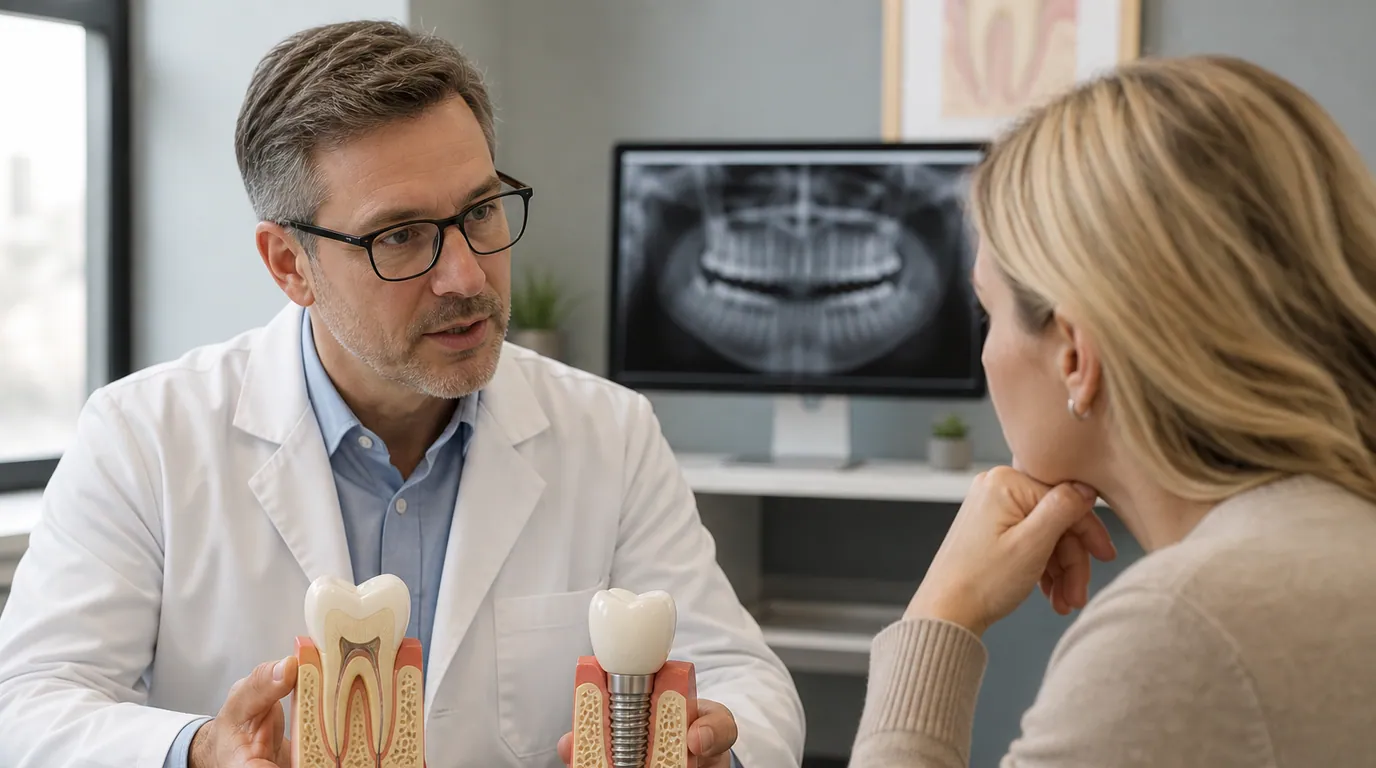
“Save the tooth or take it out?” is one of dentistry's most consequential questions. Root canal treatment plus a crown preserves your own root and periodontal ligament. Extraction plus an implant removes the problem tooth and replaces its root with a titanium fixture that supports a crown. Both paths can restore comfortable chewing, but they differ in biology, timing, cost, and future maintenance.
For patients in Mineola, Plainview, and elsewhere on Long Island, the right answer should come from the condition of the tooth—not from a blanket preference for one procedure. Meadowbrook Dental evaluates the crack pattern, remaining tooth structure, nerve and root condition, bone support, bite, and the patient's health and priorities before discussing prognosis.
Why Dentists Usually Try to Preserve a Restorable Tooth
A natural tooth has a living attachment system that helps sense biting pressure and preserves its surrounding tissues. Keeping it also avoids extraction and implant surgery. When decay or infection has reached the pulp but the root and outer tooth structure remain sound, root canal treatment removes inflamed or infected tissue, disinfects the canal space, and seals it. A crown then reinforces the weakened chewing surface.
Preservation is not the same as saving every tooth indefinitely. The goal is a tooth that can be cleaned, restored with a durable seal, and expected to function without ongoing infection. Our overview of signs that may indicate root canal treatment explains common symptoms, but pain alone cannot establish whether the tooth is restorable.
When Extraction and an Implant May Be the Better Path
Extraction becomes reasonable when retaining the tooth offers a poor or hopeless prognosis. A vertical fracture running through the root usually cannot be predictably sealed. Decay extending deeply below the gumline may leave too little tooth structure for a crown. Advanced periodontal bone loss may make the tooth unstable even if its nerve can be treated. Persistent infection after prior root canal care can sometimes be retreated, but anatomy, cracks, and prior procedural complications may limit that option.
An implant avoids relying on a compromised root and does not require reshaping neighboring teeth. Still, it is a surgical treatment with its own requirements. Adequate bone and healthy gum tissue are needed, healing takes time, and smoking, uncontrolled diabetes, grinding, or poor plaque control can increase complications. Learn more about the components and candidacy considerations on our dental implants service page.
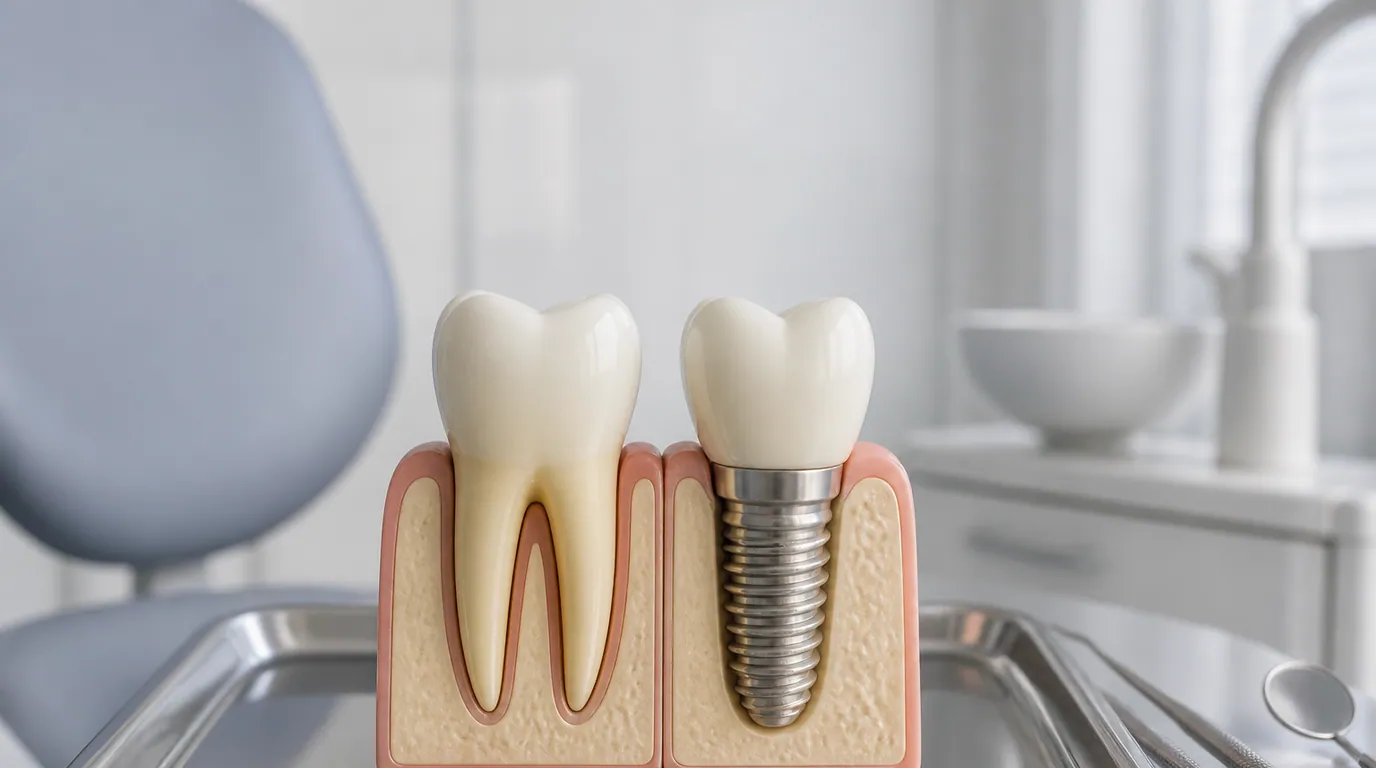
Root Canal + Crown vs. Extraction + Implant
| Decision Factor | Root Canal + Crown | Extraction + Implant |
|---|---|---|
| Best fit | Restorable tooth with sound root and adequate support | Non-restorable or poor-prognosis tooth with suitable implant site |
| Biology | Keeps the natural root and periodontal ligament | Replaces the root with a fixture integrated into bone |
| Typical sequence | Root canal, core buildup, then final crown | Extraction, possible graft, implant placement, then crown |
| General timeline | Often weeks, depending on symptoms and restoration | Often several months, depending on grafting and healing |
| Future risks | Fracture, recurrent decay, leakage, or reinfection | Gum inflammation, bone loss, loosening, or crown wear |
| Reversibility | Tooth can still be extracted later if it fails | Extraction is permanent; the natural tooth cannot be restored later |
How Prognosis Is Determined
A useful consultation should answer two separate questions: can the tooth technically be treated, and is the expected result worth the treatment burden? Dentists inspect the tooth under magnification, test the nerve and bite, measure gum pockets and mobility, and use dental X-rays. In selected cases, three-dimensional imaging or an endodontic consultation provides more detail about roots, bone, or suspected fractures.
Favorable signs include enough healthy structure above the gumline to support a crown, a repairable crack confined to the crown portion, healthy periodontal support, and canals that can be accessed and sealed. Warning signs include a vertical root fracture, decay far below the bone level, severe mobility, an unfavorable crown-to-root ratio, or a combination of problems that makes maintenance unrealistic.
Ask for the prognosis in practical terms—favorable, guarded, or poor—and what could cause failure. If the recommendation is unclear, a diagnostic general dentistry examination is the starting point, and a second opinion can be appropriate before an irreversible extraction when timing safely allows.
Compare the Full Timeline and Cost, Not One Procedure
The root canal path includes the endodontic procedure, buildup, and usually a crown. The implant path can include extraction, grafting, implant placement, an abutment, a temporary tooth, and the final crown. Comparing only “root canal versus implant placement” leaves out important parts of both plans.
Broad Long Island estimates often place a root canal and crown together around $1,800 to $3,500, while a complete single-tooth implant commonly falls around $3,000 to $5,500; grafting or other preparatory treatment can add cost. These are market context, not Meadowbrook Dental quotes. Insurance may cover components differently, and retreatment complexity can change the comparison. Our dental implant cost guide provides a fuller breakdown.
Time also has value. A restorable tooth can often receive root canal care and a crown over a shorter interval. Implant treatment may require months of healing, especially after grafting, although temporary tooth options may be available. Conversely, investing in a guarded tooth and later replacing it can mean undergoing both pathways. That possibility should be part of informed consent, not treated as a certainty.
Maintenance Matters With Either Choice
Neither a crowned tooth nor an implant is maintenance-free. A natural tooth can develop decay at the crown margin, fracture under heavy forces, or develop recurrent infection. An implant cannot get a cavity, but plaque can inflame the surrounding tissue and contribute to bone loss. Implant screws and crowns can also loosen, chip, or wear.
Daily brushing, interdental cleaning, professional maintenance, and control of grinding and smoking risks support both options. If you have widespread gum disease or several active cavities, stabilizing those conditions before definitive treatment may matter more than which replacement material is chosen.
A Simple Decision Framework
- Lean toward saving the tooth when it has a favorable restorative and periodontal prognosis, no vertical root fracture, and enough structure for a predictable crown.
- Lean toward extraction and implant evaluation when the tooth is non-restorable, severely fractured or mobile, or carries a poor prognosis after reasonable specialist options are considered.
- Pause for more information when imaging is inconclusive, prognosis labels are not explained, or you have not compared the entire timeline, cost, and maintenance of both plans.
Personal priorities also count. Surgical health, dental anxiety, treatment time, appearance during healing, budget, and willingness to maintain the result can legitimately influence the choice after the clinical limits are clear.
Frequently Asked Questions
Is saving a natural tooth always better than getting an implant?
Preserving a treatable natural tooth is generally preferred, but not at any cost or prognosis. A tooth with enough healthy structure, adequate bone support, and a repairable crack may serve well after root canal treatment and a crown. Extraction may be more predictable when the tooth is non-restorable, vertically fractured, severely mobile, or repeatedly infected despite appropriate care.
How long can a root canal and crown last compared with an implant?
Either option can function for many years, but no lifespan can be promised. Longevity depends on the remaining tooth structure, crack status, bite forces, gum health, restoration quality, hygiene, smoking, and regular maintenance. Implant crowns can wear or loosen, and implants can develop inflammation, so implants also require ongoing care.
Can I get an implant immediately after an extraction?
Sometimes an implant can be placed at the extraction visit, but only when bone, infection control, anatomy, and initial stability are favorable. Other sites heal before placement or need bone grafting. Immediate placement does not necessarily mean the final crown is attached immediately.
Should I get a second opinion before extracting a tooth?
A second opinion is reasonable when the tooth is not causing a medical emergency and the prognosis is uncertain, especially if extraction is irreversible. Ask whether an endodontic evaluation, periodontal treatment, or a different restoration could change the outlook, and compare the expected maintenance, timeline, and total treatment involved in each path.
Medical disclaimer: This article is general education, not a diagnosis or individualized treatment recommendation. Tooth restorability and implant candidacy require an in-person examination and appropriate imaging. Seek prompt care for facial swelling, fever, difficulty swallowing or breathing, or severe uncontrolled pain.
To compare the prognosis of your tooth with an implant-based plan, call Meadowbrook Dental Care in Mineola at (516) 284-1234 or Meadowbrook Dentistry in Plainview at (516) 346-5757, or request a consultation online. The goal is a clear explanation of what can be saved, what cannot, and why.
Compare Tooth-Saving and Implant Options
A focused exam can clarify whether your tooth is predictably restorable or whether extraction and implant replacement offer the sounder path.